
The Future of Persecution in Iran

In June of last year, a 12-day war began with Israeli attacks on Iran.
A month later, Iran’s Ministry of Intelligence and Security put out a statement that many people probably missed in the midst of the bigger conflict.
It said 53 people had been arrested. It called them “Mossad mercenaries.” It said they had been “trained abroad” by churches in the United States and Israel. And it said they had been operating “under the guise of the Zionist Christian evangelisation movement.”
The people they were describing were Iranian evangelical Christians. People who had converted from Islam. People who met in living rooms to read the Bible and pray.
The ministry said these Iranians had been “neutralized.”
The word “neutralized” tells you exactly how the Iranian government understands the threat believers pose. Not as a religious minority practicing their faith. But as enemies of the state.
A year later, war continues in the Middle East, as politicians and military leaders scramble to find answers for geopolitical problems no one can seem to solve.
But a less-noticed question remains: What does all this mean for Christians in Iran? What does persecution in Iran look like right now? And what will it look like in the future?
THE BIGGER PICTURE OF PERSECUTION
Mansour Borji is the director of Article18, an online organization that documents the arrests, interrogations, and prison sentences that Iranian Christians face: “You need to see it within the bigger picture—the campaign of intimidation and, I would say, eradication of Persian-speaking Christianity.”
When a crisis like war arises, authorities see an opportunity to make Christians scapegoats—people to blame for the country’s woes. This turns anger away from the officials in power and justifies persecuting a minority group for problems they didn’t create.
This kind of persecution is made possible because of how Iran’s legal system views religions. Though it is the Islamic Republic of Iran, the constitution recognises three religious minorities: Zoroastrians, Jews, and Christians.
But the label “Christian” is reserved for a very narrow group: ethnic Armenians, Assyrians, and a few Christian communities that have existed in the country for centuries.
Those Christians have certain legal, though limited, protections, including church buildings, representation in parliament, and the right to worship in their own languages.
But in reality, they are not representative of all Christians. Over the past four decades, the number of converts has surpassed the number of ethnic Armenian and Assyrian Christians. And these converts do not have a representative. They do not have a functioning church they can formally attend.
Anyone who has left Islam for Christianity is not recognised by the state. They have no legal right to worship in public or hold services. They cannot attend the established ethnic churches.
So they meet in what they call house churches. But the government calls them enemy groups.
THE CRIME OF PRAYER AND BAPTISM
Persecution against Christians is not often labeled as such. Instead, Christian activity is often dumped into broader illegal categories.
Under Article 500 bis of the Iranian Penal Code, any “propaganda contrary to the holy religion of Islam” is criminalized. In 2024, nearly 70 percent of the charges against Iranian Christians were brought under Article 500 bis.
In 2025, that figure rose to nearly 90 percent.
The persecution Iranian Christians endure isn’t just arrest or imprisonment. Borji says it also takes deeper dimensions.
“When you are not even considered a citizen, your identity in day-to-day life is challenged,” he says. “You cannot identify yourself by what you believe. For their own protection, people have to live a double life. Some choose not to. You either go with the flow and do what the authorities ask, or you are prepared to pay the consequences.”
For some, the consequences are severe. In 2025, Christians were sentenced to a combined total of more than 280 years in prison.
In one case from 2025, five Christians were sentenced to more than fifty years in prison combined. The evidence against them included praying together, baptizing people, taking Communion, and celebrating Christmas.
In another case, two Christian converts were convicted of “distributing smuggled goods.” Those goods were Bibles found inside their homes. And they weren’t even present for the trial.
That was the physical evidence: Bibles.
One woman is currently serving a ten-year sentence for giving “financial and material support” to her house church. According to the court documents, the amount she gave was fourteen dollars.
And Iranian courts have repeatedly described the Bible itself as a “prohibited book”— calling it distorted, corrupt, deviant, and misleading.
So when the government talks about threats to national security, this is often what it means: Christians praying, worshiping, giving, and sharing the Bible.
THE CHURCH THAT SURVIVES
Over the last year, some Iranian Christians outside the U.S. expressed hope for regime change. For an opportunity for religious freedom. For a chance to share the gospel without fear of punishment.
But despite huge blows to its government and military, the Iranian regime has remained defiant. And many Iranian people have grown despondent about any chance for real change.
Borji says it’s difficult, but he isn’t without hope.
“For me, hope means a church that learns its lessons through this process, matures, grows its roots deeper, and fulfils its work — not only declaring the gospel, but also being the presence of Christ in its communities,” he says.
“That is the church that survives. Not only survives, but, as it has over the past forty-some years, thrives. So I have no doubt that the church will be victorious. Whether my lifetime allows me to see it or not, I know the end of the story.”
Steven Morales:
In July 2025, Iran’s Ministry of Intelligence and Security put out a statement. It said 53 people had been arrested. It called them, quote, “Mossad mercenaries.”
Audio: News Anchor:
Inside Iran, a brutal crackdown is taking place.
… with the numbers rising fast after the recent war with Israel.
Steven Morales:
It said they’d been “trained abroad by churches in the United States and Israel.”
Audio: News Anchor:
Christians were arrested in these six cities. Officials accused them of spreading Zionist Christianity and, quote, “acting against national security.”
Steven Morales:
The people they were describing were Iranian evangelical Christians. People who had converted from Islam, people who met in living rooms to read the Bible and pray. The ministry said these Iranians “had been neutralized,” and that word tells you exactly how the Iranian government understands the threat these people pose. Not as a religious minority practicing their faith, but as enemies of the state.
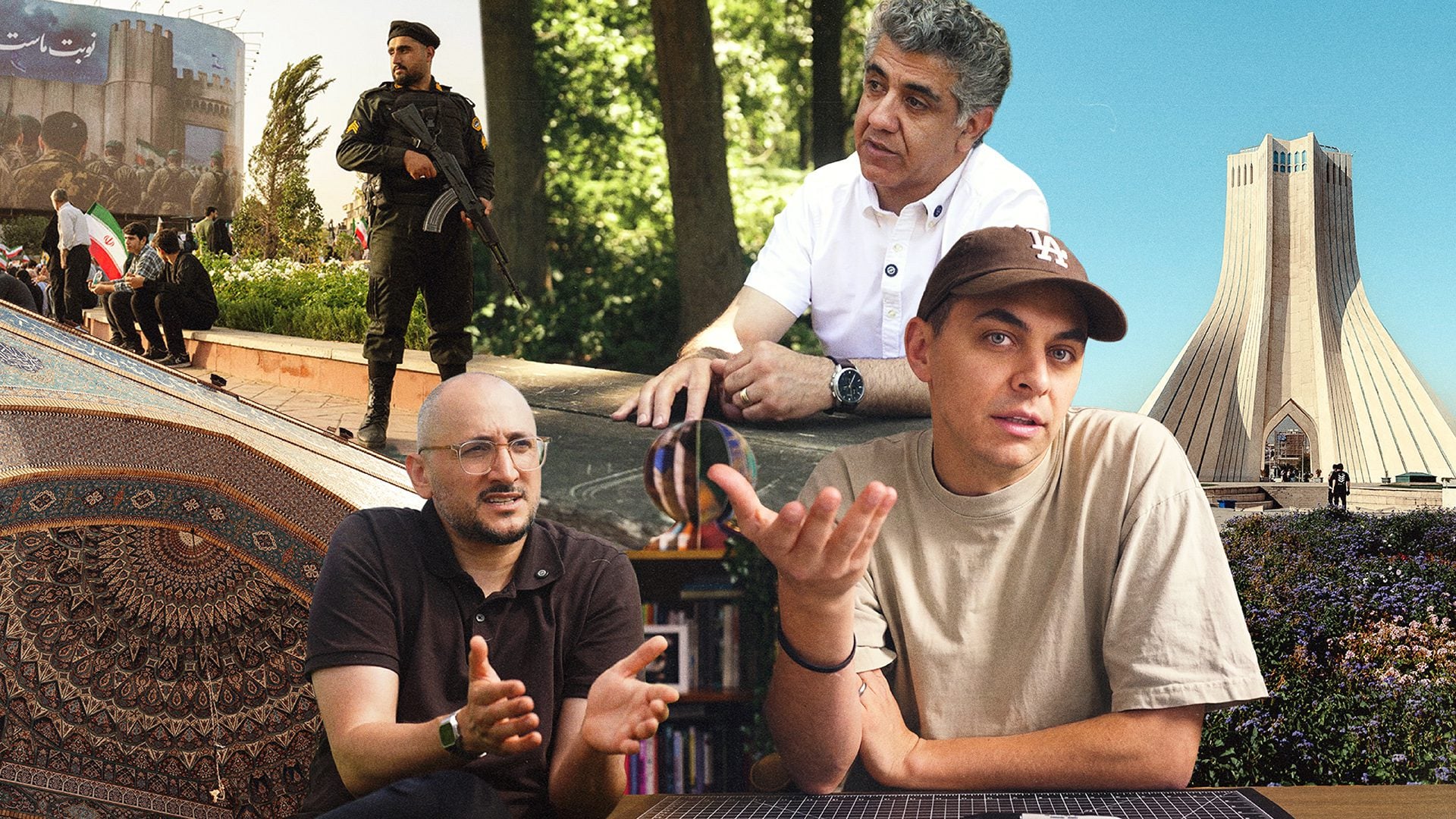
A few years ago, I traveled to Tehran to understand the pressure Iranian Christians live under every day. I arrived just one week after Mahsa Amini died in police custody, at a moment when the nation already felt like it was reaching its breaking point. But these latest reports we’re looking at are from last July, and unless you’ve been living under a rock, you’d know that things have only escalated significantly since then with no sign of stopping. So I can’t help but wonder what this all means for Christians in Iran? What does persecution in Iran look like right now, and what will it look like in the future?
After filming our last documentary on Iran, I can’t really go back. So to understand what is happening inside the country right now, we’ve traveled to London to meet with Mansour Borji, the director of Article18. For years, he has documented the arrests, interrogations, and prison sentences Iranian Christians face and helped bring stories the government wants hidden into the light.
Mansour Borji:
You being a Christian and speaking a language that is comprehensible to all Iranians, that is a red flag for the Iranian authorities. When it invites, it encourages other Iranians to join it; that’s when they could not tolerate it. You need to see it in a whole bigger picture: the campaign of intimidation and, I would say, eradication of Persian-speaking Christianity.
Steven Morales:
Now, the persecution of Christians in Iran is not random. It follows an old political pattern, one used across history by governments of nearly every ideology, and it usually begins the same way.
Mansour Borji:
When a war happens, suddenly the persecution peaks, what we call in our report scapegoating.
Steven Morales:
Scapegoating, it goes like this. A state comes under pressure- a military defeat, an economic crisis, or political instability- and rather than take responsibility, it identifies a group, usually already marginal and already suspicious in the public imagination, and it blames them for the nation’s problems.
The group doesn’t have to be powerful. In fact, it’s better if they’re not. Because the point is not to neutralize a real threat; the point is to give the people somewhere to aim their anger and to then justify their own reach for more power.
Mansour Borji:
Over the centuries, Christians in Iran, they have lived with the shadow of persecution over their head. But over the past 50 years, things have changed quite radically. Because they thought Christianity was a Western religion, there’s always been this general suspicion. You see that 200 hours after the Islamic Revolution, the first Christian is killed. The church assets are seized, and churches begin to be closed down.
Steven Morales:
All of this is made possible because of how Iran’s legal system views religions. Yes, it is the Islamic Republic of Iran, but the constitution recognizes three religious minorities: Zoroastrians, Jews, and Christians. But that label Christian is reserved for a very narrow group: ethnic Armenians, Assyrians, and a few Christian communities that have existed in the country for centuries. Those Christians have certain legal, albeit limited protections, including church buildings, representation in parliament and the right to worship in their own languages.
Mansour Borji:
Which is quite deceptive because, in reality, they are not representative of all Christians because over the past four decades, the number of converts has superseded the number of ethnic Armenian and Assyrian Christians. And they don’t have a representative; they don’t have a functioning church they can go to formally.
Steven Morales:
Anyone who has left Islam for Christianity is not recognized by the state. They have no legal right to worship in public or hold services. They can’t attend the established ethnic churches. So they meet in homes, what they call house-churches. But the government calls them something else, “enemy groups.”
Mansour Borji:
Then the church entered a period when there was suffocation or squeezing of the church. When that didn’t work, the government made that very strategic mistake. They went from squeezing to crushing. Now, it was not just major cities that had a limited number of churches, which gave birth to underground house-churches. But then now in every village, every town, people were coming to Christ. And that’s when the Christians and Christian activities were labeled as a threat against national security.
Steven Morales:
This is really important to understand. Persecution against Christians is not often labeled as such. Instead, Christian activity is often dumped into broader illegal categories. And Iran, under Article 500 bis of the Iranian Penal Code, says, “Any propaganda contrary to the holy religion of Islam” is criminalized.
Now, civil liberties groups warned from the beginning that the law was so broad it could turn almost any expression of a minority faith into a crime, and they were right. In 2024, nearly 70% of the charges brought against Iranian Christians were brought under Article 500 bis. In 2025, that figure rose to nearly 90%.
So if persecution is often hidden behind other charges and given another name, how do we recognize what it really looks like?
Mansour Borji:
It’s a multi-layered reality. It’s not just physical. Somebody has been arrested, imprisoned, tortured. It’s not most obvious one and something that prompts reaction. But then there are deeper psychological ones, faith-related ones. When you’re not even considered a citizen, your identity in day-to-day life is being challenged. You can’t identify yourself or what you believe. You have to live a double life because of their own protection. Some of them, they choose not to because you either choose to go with the flow, with what the authorities ask you, or you pay, you prepare for the consequences. And that’s just a psychological level.
But there’s also, when we talk about prisoners and arrests and detention, people who are affected in a secondary way. That’s the families, the wives who have left with three kids whose husband was arrested and put in prison for 10 years for possession of a Bible. He didn’t get to see the birth of the third child, and every day in prison, has to just imagine what hardship his family will go through. His wife also is concerned about her husband inside, but how am I going to raise his kids and face all those challenges alone?
Steven Morales:
In 2025, Christians were sentenced to a combined total of more than 280 years in prison. That figure was higher than in 2024, despite involving fewer convicted individuals, which means that the average sentence length increased.
Now, this is where things take a darker turn. In 2025, Iran and Israel fought a 12-day war. The ceasefire came on June 24th. In the six months before the ceasefire, 40 Christians had been arrested. In the single month after it, 54 were arrested across at least 19 cities, including Tehran, Mashhad, Isfahan and Shiraz. That jump is not a coincidence; it’s a response. The war gave the regime something it has used before: a national security excuse for cracking down at home, and the scapegoating started fast.
Mansour Borji:
Many of them talk about the shock. Suddenly, the door is knocked and 10, 15, sometimes 30 agents raid the house, shouting, yelling at you. Kids are afraid. They rattle you basically to get you unstable in your thinking about what is happening, and that’s a technique to get the information from you. Putting you blindfolded in a car, not having to communicate anything with your family or relatives or media, and dragging you to a detention center. You haven’t even seen a police station in your life, and suddenly, you’re in solitary confinement, blindfolded, given a very dirty blanket in a really cold cell. Every moment of it is torturous because you don’t know if they’re coming to take you for interrogation. Are they going to execute you?
There’s an immense psychological pressure. The intimidation, the threats against your family, being deprived of medical care, basic needs. And then they bring you to a point where you break.
Steven Morales:
For most Christians in the West, this is an unimaginable situation to be in, but it’s what many Iranian Christians faced just the last year. Iran state media showed footage of arrested Christians meeting in Turkey, surveillance of Bibles supposedly being smuggled into Iran, and forced confessions from detainees admitting that they had been traveling abroad for religious training.
Then the intelligence ministry issued its statement. It said these people were “Mossad mercenaries,” trained abroad and operating under what it called a “Zionist Christian evangelization movement” to take down the Islamic regime. UN human rights experts warned Iran that religious minorities faced, in their words, “an intensified risk of being scapegoated” and that the arrests likely violated international law. But Iran did not respond.
While I was in London, I was also able to meet with Mojtaba. He was imprisoned twice in Iran for his faith, one of those times for over three years, and his story shows us what persecution and scapegoating actually look like.
Mojtaba:
I was born in Iran in a city called Shiraz. I became Christian, converted from a nominal Muslim background, which was illegal and is still illegal to practice your Christian faith, especially as a converted Christian. I was 18 when I encountered Jesus and became Christian.
Two years after this conversion, I was arrested because of my faith. And being imprisoned, it was one of those moments that you say, “I’ve had enough.” I was very overwhelmed. And I was missing my family; I was thinking about my future. I was like, that life condition I had, the circumstances, living among criminals. Everything was in my mind; I was thinking about all these things.
Especially in solitary confinement in such a small room, two meters by six meters, there was nothing in that room. And when you are there, it’s like the end of the world. It’s like you are here for the rest of your life because you are absolutely disconnected from the world outside. You don’t have any information about what’s happening. You don’t know the time, you don’t know the date, and it’s just like you are no one. It’s like you didn’t exist. It’s like you are in, literally, it’s like you are in a grave all on your own, nothing there.
Mansour Borji:
And they try to steal hope that nothing is going to benefit if you continue to resist. And that’s when you begin giving information, even forced confessions. They tell you, “This is what I need you to say, write,” because that interrogator wants to make a strong, solid case and win this with his superiors. So they force a confession out of you that could incriminate other Christians, and you feel guilty about it afterwards. Sometimes they even force you to deny your faith, which brings you shame and all the spiritual consequences. And then the lengthy court proceedings and possibly imprisonment.
Torture is part of it, but also psychological torture. I’ve been quoted several times; it’s worse than physical torture because the impact of it remains with you for a longer and longer time. After years, when my doorbell rings, I still feel shaken and frightened. That’s the kind of trauma we’re talking about. Or a child who, when he was like five, saw his parents being arrested and dragged away, now cannot see, in his teenage life, his parents go to the shop to buy something because he feels they may be taken and not come back. That’s the kind of impact it will have. It paralyzes you.
Mojtaba:
After I got released, I came out of prison after three years. I was in my room in silence in my comfortable bed. And now in this silence, all those hurts, wounds, and emotions- the things I experienced- it was coming up. And I started feeling guilty as well, like it was my mistake that my family went through this. Maybe I did the wrong thing. Maybe prison was wrong, maybe that persecution was wrong. What’s happening to me? After three years of standing in front of the judge and living among criminals, leaving everything behind, doing all the fighting and battles in Christ.
Steven Morales:
Three years in prison is a serious punishment. So what exactly did Mojtaba do that the Iranian government believed he deserved it?
Mojtaba:
I think the first week we were in prison, people were interested. Usually, they are interested in any new people, just asking their story, where they’re from, which gang they’re part of, how they got arrested. And as soon as we would say, “Oh, I’m a Christian, I was arrested in church,” they were so confused. So we were very strange prisoners to the other prisoners. They had never heard such a crime, Christians.
Steven Morales:
The charges brought against Christians can sound serious until you look at what they’re actually describing. In one case from 2025, five Christians were sentenced to more than 50 years in prison combined. The evidence against them included praying together, baptizing people, taking communion, and celebrating Christmas.
In another case, two Christian converts were convicted of distributing smuggled goods. Those goods were Bibles found inside their homes, and they weren’t even present for their trial. That was the physical evidence: Bibles. One woman is currently serving a 10-year sentence for giving financial and material support to her house-church. According to the court documents, the amount she gave was $14.
And Iranian courts have repeatedly described the Bible itself as a prohibited book, calling it distorted, corrupt, deviant and misleading. So when the government talks about threats to national security, this is often what it means. Christians praying, worshiping, giving and sharing the Bible.
Mansour Borji:
Christians are seen, in the terms they use, “mercenaries of the West,” just because they’re not aligning themself with the ideology of the Islamic Republic. This is not our analysis or opinion; this is taken exactly from the statement issued by Iran’s Ministry of Intelligence that labels them as such. So hate speech, blaming, labeling game is part of this scapegoating.
Steven Morales:
So what am I getting at with all this? Well, that the persecution of Christian converts in Iran is not just a collection of isolated arrests or unusually harsh court cases. Underneath the politics is something deeper. The government is not only threatened by what these Christians do, but it’s also threatened by what their faith represents.
Mansour Borji:
If you’re familiar with the ideological basis or foundations of the Islamic Republic, you definitely are not going to take that naïve position that things are going to improve in this system. It’s never going to improve in this system because its survival is based on the protection of very rigid boundaries around what is seen as acceptable to God, Allah, or not acceptable. And the guardians of that are the religious zealots. Breaking that boundary is the end of the Islamic Republic. So, so long as they’re in power, things are not going to improve for religious freedom for Christians or anyone.
Steven Morales:
At the heart of all of this is a theological and political commitment to Shia rule. Leaving Islam, it’s not seen as a personal, private choice. It’s treated as a challenge to the state itself. And facing this kind of persecution can feel utterly hopeless.
Mojtaba:
The dictatorship is their nature of them and I know the church will always be physically persecuted through the government, even the faith battles and the spiritual battles in the future. There are so many challenges; persecution, physical persecution is one of them. Even if the church is free, there will be lots of challenges, especially people coming from all this trauma and pain.
Mansour Borji:
The constant pressure on the church is not something new. The early church had this constant pressure and suppression. But they, nevertheless, continued their faithful ministry, and they got to a point when there was no point in fighting them anymore. And a tiny group of people, as the book of Acts of the Apostles says, were able to shake the four corners of the Earth brought an empire onto its knees.
Mojtaba:
We are there, despite everything, even if the government changes or not. God’s plan, God’s plan never stops for Iran for the salvation of people. That’s why sometimes people were being persecuted in prison. They don’t really think about coming out of prison because they say prison or out of prison is where God’s gospel and salvation are needed.
Mansour Borji:
For me, hope means a church that learns its lessons through this process, matures, grows its roots deeper, and fulfills its work declaring the gospel, but also being the presence of Christ in their communities. That’s a church that survives. Not only survives, but as the last 40-some years, has thrived. So I have no doubts that the church will come victorious. Whether my lifetime will allow me to see that or not, I know the end of the story.