A Christian Visits Hindu Temple of Death
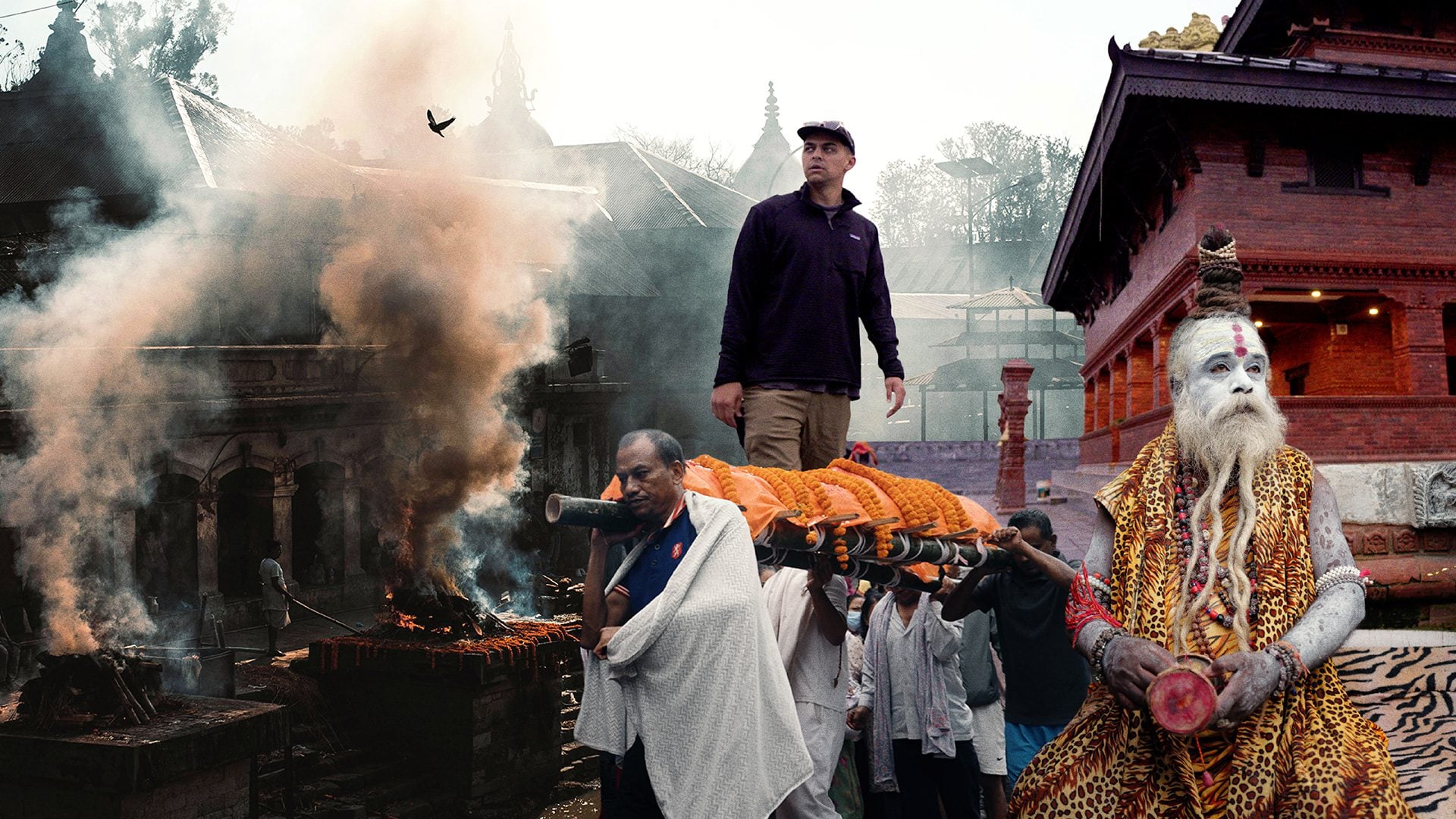

Smoke rises over Kathmandu. Not from a factory, not from a cooking fire, and not from a warm home tucked into the hills. This smoke has a name: a father, a mother, a husband, a wife, a child, a friend.
On the banks of the Bagmati River, at Nepal’s Pashupatinath Temple, families bring the people they love for the last time. Bodies are carried down toward the water, covered with flowers, wrapped with care, surrounded by relatives, priests, and grief. Then the fire is prepared, and everyone watches as death burns in the open air.
For many Western visitors, death is usually hidden away. It happens behind hospital doors, behind funeral home walls, behind polished ceremonies that soften the sharpest edges of loss. But at Pashupatinath, death is public. It is visible. It is sacred. It is impossible to ignore.
Standing there, with smoke in the air and families gathered on the river steps, one question becomes unavoidable: What happens after the fire goes out?
Why Pashupatinath Matters
Pashupatinath is one of the most sacred Hindu sites in Nepal and one of the most important Shiva temples in the world. Located on the banks of the Bagmati River in Kathmandu, the temple is dedicated to Shiva, worshiped here as Pashupati, a name often understood as “lord of animals” or “lord of all living beings.”
But Pashupatinath is not only a place of worship. It is also a place of death. The temple’s cremation ghats are where Hindu families come to perform funeral rites for their loved ones. Its cremation services help families carry out last rites with dignity and according to Hindu tradition.
So as bells ring, pilgrims move through the complex, and sadhus sit nearby in ash-covered stillness, families gather at the river to say goodbye.
Shiva and the Cycle of Life
To understand Pashupatinath, you have to understand something about Shiva. In Hinduism, Shiva is one of the most significant deities, often associated with destruction, asceticism, meditation, transformation, and renewal. But destruction in Hindu thought is not merely chaos. It can also be part of the cosmic rhythm by which one form gives way to another, one age gives way to the next, and one life gives way to another birth.
That makes Shiva especially significant in conversations about death. Death is not treated only as an ending, but as part of a larger cycle. In Nepal, Shiva is worshiped at Pashupatinath as Pashupati, the lord of living beings. The temple complex, the river, the cremation ghats, the rituals, and the worship all hold together a vision of reality in which life and death are not separate subjects. They belong to the same wheel.
The Wheel of Samsara
In Hindu belief, death is not the end. The soul, or atman, continues through birth, death, and rebirth in a cycle known as samsara. Karma—the moral weight and consequence of one’s actions—shapes that cycle, and the ultimate goal is moksha: liberation from samsara, release from the repeating pattern of birth, death, and rebirth.
That means death is not viewed as final in the same way a secular worldview might view it. But endlessness is not the same thing as assurance. If karma shapes the next life, then the question remains: What comes next? Another human life? A lower form of life? A better station? A worse one? A step closer to liberation? Another long journey through suffering?
Standing beside the Bagmati, watching the smoke rise, this was the weight we felt. The question was not merely, “Does life continue?” The deeper question was, “Where does it go? And who can say with certainty?”
What Happens at the Cremation Ghats
As we walked through Pashupatinath, our guide explained the cremation process unfolding in front of us. The body is brought to the river. Family members gather close. Ritual washing, offerings, flowers, and prayers accompany the final farewell. Then the body is placed on the pyre, and the fire is lit.
Hindu funeral rites, often referred to as antyeshti, commonly involve cremation followed by the placement or scattering of ashes in sacred waters. At Pashupatinath, the Bagmati River becomes part of that final act. It carries away ashes. It receives grief. It stands between this life and whatever comes next.
For the families gathered there, this is not a tourist spectacle. It is the most painful moment of their lives. They are not acting out an idea. They are saying goodbye to someone they love.
That matters. Christians should never watch a scene like this with arrogance or detachment. We should watch with compassion. We should recognize the tears. We should honor the grief. We should remember that every person on those steps bears the image of God. But we should also pay attention to the spiritual weight of what is being said.
In Hinduism, death is not defeated. It is repeated. Another life. Another birth. Another body. Another death. The wheel keeps turning.
When Death Gets Under Your Skin
One of the people with us that day was Lenduk, a Nepali Christian. He was not merely observing Pashupatinath as an outsider. He knows Nepal. He knows the religious atmosphere. He knows what these places mean to the people who come to them.
And the experience disturbed him deeply. Afterward, he told us that what he saw stayed with him. It followed him into the night. He had nightmares. He felt the heaviness of the place—not just emotionally, but spiritually. For him, Pashupatinath was not only a cultural site. It was a place that reminded him of the need to pray when Christians enter spaces shaped by worship, death, fear, longing, and spiritual confusion.
That is not because Christians should be afraid of places like this. It is because we should be awake. There are moments when theology stops being abstract. Words like karma, samsara, death, hope, and resurrection are no longer ideas in a book. They become smoke in your lungs, faces on the riverbank, and families standing beside a fire. In those moments, prayer feels less like a religious habit and more like the only honest response.
The Christian Hope Is Not Another Turn of the Wheel
Pashupatinath should make Christians think carefully. The families on those steps are doing the hardest thing human beings do: saying goodbye to someone they love. The religious tradition surrounding them offers an answer to that grief. Death is not the end. The wheel keeps turning. The soul continues. Liberation is possible.
That is an answer. But Christianity says something different. And stranger.
Christianity does not offer another turn of the wheel. It claims that the wheel has been broken. At the center of the Christian faith is not a vague hope that something continues after death. It is the historical claim that Jesus of Nazareth died, was buried, and rose again—not as a different being, not as an abstract spirit, not as a soul dissolved into the universe, but as Himself.
We want to speak about Hinduism with humility. Millions of Hindus are not engaging these questions casually. They are seeking truth, honoring family, practicing devotion, and trying to make sense of suffering, death, and the moral order of the world. There is something deeply human in that.
But as Christians, we believe the gospel offers a better hope than endless rebirth. Not because Christians are wiser or better, but because Jesus is better. The resurrection says that death will not be recycled forever. It will be undone.
That is either true or it is not. But if it is true, it changes everything about what we watched on those steps in Kathmandu. Because when the smoke rises, Christianity does not tell us to look for another turn of the wheel. It tells us to look for an empty tomb.
Steven Morales:
Smoke rises over Kathmandu, not from a factory or from a warm fire in a home. This smoke has a name, a father, a mother, a loved one. Here on the banks of the Bagmati River, families bring the people they love for the very last time. They carry them down and cover their bodies with flowers, fragrances, and a fire is prepared, and then everyone watches as death burns in the open air. But what happens after the fire goes out?
In Hinduism, death is not the end, but endlessness is not the same thing as hope. For many, death is another turn of the wheel, another life, another birth, another body, another death. Death is not defeated; it’s repeated, and over every life hangs the weight of karma. Was this life good enough to earn a better one? How many lives will it take to finally be free? And when the smoke rises, who can tell you whether you’ve done enough?
So, I’m in Nepal, and I came here because I didn’t want to just learn about Hinduism in the abstract as a set of beliefs, or ideas, or philosophies. I wanted to see how people actually lived inside of those beliefs and how faith shapes the most ordinary and painful parts of life, and nowhere does religion become more honest than at the edge of death. And for Hinduism in Nepal, there may be no place where that’s more visible than Pashupatinath.
Nepali man:
This is one of the best pilgrimage destinations; as Muslims go to Mecca, Christians go to the Vatican. And Hindus, once in a lifetime, they must come to Pashupatinath to worship Lord Shiva, which is called Mahadeva. So Pashupatinath is the place we have a person going to learning life and death. So the cremation is 24/7. All day, all night, it never stops. The river Bagmati, it joined to the India, Ganga in Varanasi. If someone passes away, it must be cremated the same day. Same day, but different levels of caste and different ethnic groups have a little bit different cremations. We have a place for ordinary family, somewhere place for high-ranking diplomatic families who pay more money. And most Nepali, we just see the body lying there lying down. It’s called Savasana.
In Nepal, when the mother passes away, the younger son he set the first fire, but the family has to wait in there to watch, to see, to feel, and then all the ashes go to the river. If you have a really pure spirit, your soul is going to heaven. Otherwise, god gives us several chances to come back to purify ourselves, to become nice and go to heaven, like a samsara, the wheel of life.
Steven Morales:
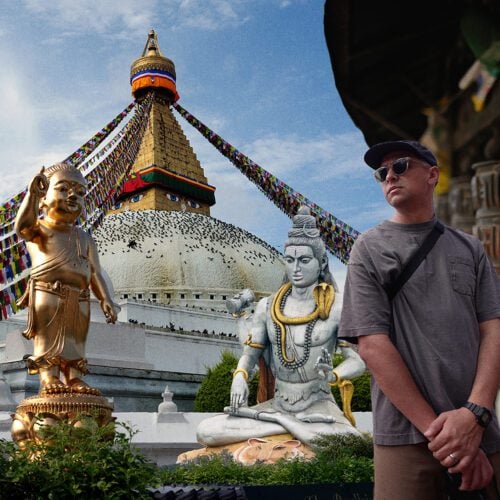
So let’s pause there and talk about Shiva and this wheel of life. Shiva is one of Hinduism’s most important gods, often associated with destruction, transformation, meditation, and renewal, but destruction in Hindu thought is not just chaos. It can also clear the way for reincarnation for a new cycle of life to begin, which makes Shiva especially significant in conversations about death. Visually, he’s often shown with matted hair, a crescent moon, a third eye, a serpent around his neck, and the Ganges flowing from his hair. In Nepal, Shiva is worshiped in a particularly important form, Pashupati, meaning lord of animals or lord of all living things. So Pashupatinath in Kathmandu is devoted to Shiva as Pashupati, but this place is not just a temple. It’s a place where worship, pilgrimage, cremation, grief, and death all meet beside the river.
The mourners bring their dead and clean their bodies, and then lay them on top of these stacks of wood and hay and burn them, and just can’t help but feel the weight of lostness. These people spend their whole lives passionately devoted to the worship of these false gods who demand so much and deliver nothing.
Hindu man:
The body may perish, but something remains. There is certainly another birth. What form birth takes I cannot say. I am human now, but I cannot claim I will be born human again. It depends on my actions. If I commit sins, I may be born as an ox, forced to toil in the fields, because I failed to live righteously. But if I act with dharma and awareness in this life, I may be born human again and move closer to liberation.
Steven Morales:
And it all ends here. It all ends here with your body burnt, cast in the river, and people digging through the water to grab all the gold that was left of your jewelry, and it just feels utterly hopeless.
Lenduk:
They believe in reincarnation, but not sure. It might be the animal. It might be the bird.
Steven Morales:
Imagine spending your whole life trying to earn your way into a better next life, never knowing if you’ve done enough. This is the hopeless reality of Hinduism when it’s actually lived out, and that kind of hopelessness runs deeper than we can see. Places like this are darker than we expect, and truth be told, we weren’t prepared for how real that darkness would feel; not even Lenduk, who’s from here, could shake it that night.
Lenduk:
It’s very in a dark place. It’s very in a demonic place.
Steven Morales:
Have you ever experienced something like that before?
Lenduk:
Not like this, not like this kind of experience. I felt that one. I felt that one. It’s difficult. I very difficult. I slept yesterday because of the spiritually strong place that this kind of thing is, because they worship idols, they worship the spirit of a bad spirit, and we should have prayer for this kind of thing. We should pray; that’s what I realized.
Steven Morales:
Yeah.
Pashupatinath is a place that should make Christians think twice. Those families are doing the hardest thing a person does, saying goodbye to someone they love. And the tradition surrounding them has its own answer to that grief: that death is not the end, that the wheel keeps turning, and that’s an answer for death. But here’s where Christianity says something different and stranger: it doesn’t offer another turn of the wheel. It claims the wheel stopped, that a man died. And instead of cycling back into something else, he came back as himself, same body, recognizable, scarred even, not dissolved into the universe. He’s actually present.
Samsara is trying to solve the problem of suffering by escaping it, but the resurrection says suffering and, ultimately, death gets undone. So the hope of the gospel isn’t just that something continues after death; it’s that the specific person you lost, the one whose face you know, isn’t gone; that all grief and suffering doesn’t have to take another lap. It has a finish line. Now, that’s either true or it isn’t, but if it is, it changes everything about what we’re watching on those steps and the hope we have in Jesus to face death.