
Did Christianity Survive the Taliban Takeover?
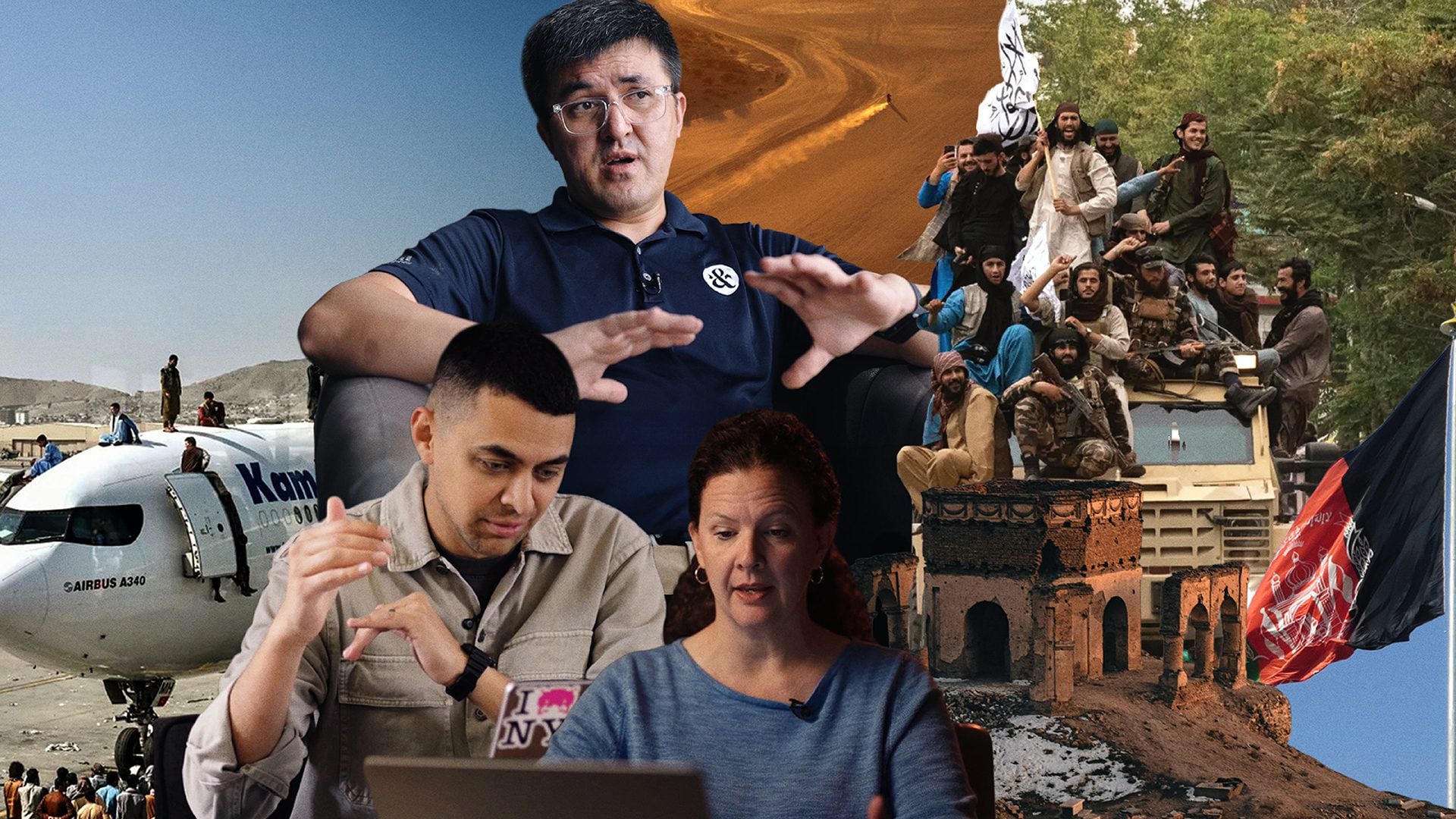

In August 2021, the ground shifted beneath Afghanistan. In a single week, life as people knew it unraveled. When the final American plane lifted off, Kabul’s airport shut down completely—no commercial or military flights coming or going. In the midst of the collapse, tens of thousands of Afghans were scrambling for a way out, including Christian believers who now faced almost certain death. Global news coverage was relentless for weeks. But months later, in May 2022, a Taliban spokesman told Voice of America: “There are no Christians in Afghanistan.”
To understand the truth behind that statement, you have to hear from Afghan believers themselves—people who lived through the takeover and know what life is like now. One of them is Ramazan Rafee, born into a devout and radical Muslim family where Sharia law was strictly enforced.
DID CHRISTIANITY SURVIVE THE TALIBAN TAKEOVER?
Ramazan grew up surrounded by mullahs. His family expected him to become a radical Muslim just like the men he admired. But as he grew older, questions began to surface—dangerously honest questions about the nature of God, human suffering, and the suffering of his own Hazara people, who had been persecuted and killed by the same Muslim authorities he was taught to respect.
Those questions eventually crossed what Islam considers a “red line.” In a moment of desperation, Ramazan openly insulted Muhammad, the Qur’an, and Allah. Under Sharia law, that amounts to apostasy, and the punishment is death.
His father, a respected imam, took up his rifle and told him plainly, “I will kill you.” Ramazan wasn’t yet a Christian—he was simply admitting he could no longer believe in Islam. But that alone was enough to cost him his life.
His mother stepped between them and said, “Kill me first, then Ramazan.” That act gave him just enough time to flee. On a motorbike, he left his home behind and rode toward Kabul.
YOU CAN’T FIND BIBLES IN AFGHANISTAN?
Even after leaving home, Ramazan still believed there had to be a Creator. He explored Buddhism and Sikhism, but the idea of reading the Bible kept growing stronger. The problem was simple: you can’t just buy a Bible in Afghanistan. You can’t even ask for one safely.
The impossibility only fueled his curiosity. “You can find Hitler’s book,” he thought, “but you cannot find a Bible. Is it that bad?”
One day in a Kabul internet café, he spotted a foreigner in Afghan clothes. Ramazan instantly recognized he wasn’t local—and took the risk of asking him directly for a Bible. Both men understood the danger. Either one of them could be reporting the other.
The foreigner told him to return the next day at 1:30.
To Ramazan’s astonishment, the man was a Christian and had access to Scripture. He handed him a New Testament and quietly offered to read it with him. Ramazan didn’t know if this was still a trap, but he opened the Bible anyway.
WHAT CAN A NEW CHRISTIAN DO HERE?
God used that single relationship—and that single copy of Scripture—to bring Ramazan to faith. But becoming a Christian in Afghanistan raises a difficult question: what can a new believer do in a country with no legal churches, no Christian bookstores, and no public Christian presence?
The answer is simple and profound: they do what the Bible shows believers doing. They pray. They worship in secret. They read Scripture. And eventually, they start sharing the gospel.
Ramazan came to faith in 2009 and immediately began telling others. Within a year, twelve individuals and two families had come to Christ. When the missionary who discipled him eventually left the country, Ramazan was suddenly shepherding a small community of believers—alone.
They were not the only ones. An underground network of Afghan Christians was slowly growing in the city. But the danger was real. In 2014, the Taliban attacked a house church belonging to one of Ramazan’s friends. They killed him, his son, and his daughter, and destroyed everything. It was a sobering reminder of the cost.
And still, the church grew. Some believers even took the extraordinary risk of registering as Christians on their national ID cards. It meant they could not open bank accounts, buy property, or even rent a house. But they wanted their identity to be clear—whatever the cost.
AFGHANISTAN’S DARKEST MOMENT
That decision would catch up to them in 2021, during what Ramazan calls the darkest moment for Christians in Afghanistan.
On August 14, Ramazan was again in an internet café when he learned that the Taliban had taken Mazar-e-Sharif. “It’s finished,” he thought. “Tomorrow they will be in Kabul.”
The next morning proved him right. He woke up, kissed his wife and two young children, and told himself it might be their last day together.
The Taliban swept into the capital. Panic overtook the streets. Crowds surged toward the airport, some clinging to moving planes out of desperation. For Christians—especially those with “Christian” on their ID cards—the danger was immediate. Believers rushed to Ramazan’s house to wipe laptops, destroy documents, and hide anything that could expose the community.
An Afghan pastor drove Ramazan’s family to safety. When his wife asked what would happen next, he could only respond: “I don’t know.”
International friends worked tirelessly to evacuate Afghan Christians, but it was chaotic. Some escaped. Others never reached the airport. Those left behind moved constantly to avoid detection. Ramazan’s group narrowly missed being present during a devastating airport bombing.
“GOD WANTS US TO DIE HERE.”
Ramazan and his family never made it onto the evacuation flights. Days turned into weeks. Every possible route for escape seemed to close. For 36 days, they moved from place to place, praying, hiding, and fearing capture.
When the final plane left the airport, Ramazan felt abandoned by every earthly solution. “It’s over,” he thought. “Probably God wants us to die here.”
His prayer was heartbreaking: if the Taliban caught them, he begged God to let them all be killed together so his wife and children wouldn’t be taken.
He wrestled with God night after night, crying out like the disciples waking Jesus in the storm. But God steadied him through one simple song: Christ Will Hold Me Fast. Listening in the darkness, Ramazan felt Jesus calm his soul. He whispered, “God, I will trust in you.”
Not long after, a security team moved them from Kabul, driving through nine Taliban checkpoints under cover of night. After 36 days, they made it out—first to the north, then out of the country entirely. When they finally passed the border, Ramazan laid down and said, “It’s over.” In Doha, Qatar, he opened Psalm 18: “God, you are my rock.”
AFGHAN BELIEVERS TODAY
Ramazan and his family first landed in Qatar, and later joined the growing Afghan Christian diaspora scattered across the world. Some are planting Afghan churches. Others join local churches in their host countries. But all of them carry a deep burden for the believers still inside Afghanistan.
Despite the Taliban’s public claim that no Christians remain, a small number of believers do still live in the country. And remarkably, some new believers have come to Christ after the Taliban takeover—despite the increased danger.
Many Afghans have grown disillusioned with life under the Taliban’s rule, which can create unexpected openness to the gospel. But ultimately, the reason is spiritual: the Holy Spirit moves. As Ramazan puts it, when people become hungry and thirsty for Christ, fear no longer has the final word. They know the risk—and they still say yes.
THE REMNANT
The underground church in Afghanistan today is small, scattered, and under immense pressure. Most believers cannot gather in person. They connect online, meeting with Christian partners who offer prayer, discipleship, and training. Many long for the day they can gather freely again. Some have never even met another Christian face-to-face. Many have never been baptized.
This is not a revival with massive numbers. It is a remnant—a small community held fast by the grace of God.
Ramazan often reflects on how God strengthened the church during those earlier, dangerous years. In the darkest moments, believers spent more time praying, worshipping, talking, and encouraging one another. They watched God “move the pieces of their lives” in unmistakable ways.
Now, in safety, he still senses God’s presence—but not in the same intense way. Sometimes he even wonders whether believers experience God more vividly in danger because they depend on him more deeply.
And yet, he knows the truth: the same God who held them fast in Afghanistan continues to hold them fast today—leading a small, courageous remnant that refuses to disappear.
Steven Morales:
Maybe you vaguely remember what you were doing in August 2021, but if you’d been in Afghanistan, you’d remember exactly where you were.
News Anchor 1:
At this hour, the Kabul Airport is shut down. No commercial or military aircraft are leaving or landing.
News Anchor 2:
Tens of thousands of Afghan civilians are scrambling to get out of the country, among them are Christian believers who face certain death.
Ramazan Rafee:
When the last airplane left Afghanistan, I said, “Okay, it’s over. Probably God wants us to die here.”
Steven Morales:
In all the news that followed after the Taliban takeover, there was this one online report from Voice of America. It was May 2022, and a Taliban spokesman declared, “There are no Christians in Afghanistan.” Was this true? Is it true now? To find out, we have to talk to an Afghan Christian who was there when it all went down, and who knows what’s happening now.
Ramazan Rafee:
I’m Ramazan Rafee. I’m from Afghanistan. I was born in a devout Muslim family. They were Mullahs, we call Mullah, and they applied Sharia, did whatever Sharia tells you. They applied that. They were radical, and they wanted me to be a radical Muslim as well.
Steven Morales:
Jamie, so you interviewed Ramazan. What first jumped out to you about his story?
Jamie Dean:
Well, I thought it was interesting that he had become a Christian in a country that’s 99% Muslim and that he had found God through doubting. And that was a problem in one of the most Muslim nations on earth, with a father who was one of the most devout Imams in town.
Ramazan Rafee:
In Islam, they give you a boundary. If you walk other side of that red line, then they label you as an infidel. I had a lot of questions about the nature of God, human suffering, and my people, who suffered a lot. Around 60 to 62% of Hazara people died; they were killed by the authorities. But those authorities, they were Muslim as well.
So all of these questions came together, and in that moment, I insulted Mohammed, I insulted the Quran, I insulted Allah. According to Islamic Sharia, if a Muslim were to convert to Christ or any other religion, then you have to die. You have to be killed. Especially from my father, he had a rifle, and he took his rifle, and he said, I will kill you.
Steven Morales:
Wait, so this is his father?
Jamie Dean:
Yeah, this was his father. I mean, remember apostasy from Islam is punishable by death in this region, and apparently, his father was prepared to carry that out even against his own son. But at this point, Ramazan wasn’t saying he believed in Christianity. He was saying he didn’t believe in Islam.
Steven Morales:
So it sounds like Ramazan had crossed that red line.
Jamie Dean:
Yeah, he definitely did. And it was a pretty dramatic moment for his whole family
Ramazan Rafee:
And my mother, Jentin, and she said, first kill me. And then Ramazan, I left my home, and I traveled by motorbike to Kabul.
Steven Morales:
So what’s next for Ramazan?
Jamie Dean:
Well, at this point, he’s still searching. He can’t quite give up on the idea of a creator. So he starts looking into other religions. What does Buddhism say? How about Sikhism? And then one day, he gets another idea: maybe I should read the Bible.
Steven Morales:
All right, but that doesn’t sound easy. I mean, could you even find a Bible in Afghanistan?
Jamie Dean:
Well, I mean, not easily. I mean, you certainly can’t just go and buy one. And the fact that Ramazan couldn’t find a Bible only made him want to read it more.
Ramazan Rafee:
You can find Hitler’s book, but you cannot find the Bible. Is it that bad? I thought there was something going on. Let me find it. And one day I was in an internet cafe in Kabul, and when I saw this guy, he had done Afghan clothes, but yeah, I realized he’s not Afghan. Immediately, I asked him, I want a Bible. I knew that was weird for him to know whether that was true or not. And he told me, tomorrow, 1:30, be here at the same location.
Steven Morales:
So this is actually something that happens a lot in places where Christians are persecuted, and you’re not sure if you trust the other guy. And I guess that’s what’s happening right now, neither guy knows if the other one is potentially a threat.
Jamie Dean:
That’s exactly right. But amazingly, it turns out this foreigner was a Christian, and he did have access to a Bible. He’s still not sure if this is a trap, but he takes the risk, and the next day, he hands Ramazan a New Testament and agrees to read it with him in secret.
Steven Morales:
It’s amazing to see how God can use one guy in the Bible to bring someone new to the faith. But in a country with no churches, where Christianity is essentially illegal, what do you do with that new believer? What does a new Christian do?
Jamie Dean:
Well, they start doing what they find in the Bible. I mean, little by little, they pray, they read the scriptures, they worship, they seek Christ, and they start telling other people about Jesus.
Ramazan Rafee:
When God saved me in 2009, I was on fire. I shared the gospel with my family, friends, and classmates. And about a year ago, we were 12 individuals and two families, and they came to Christ. And the interesting part is that this missionary brother, he left the country. When he left the country, I was alone with a bunch of people whom don’t know what to do.
Steven Morales:
So what was the rest of the religious landscape looking like at this point? Were these the only Christians in the city?
Jamie Dean:
No, they weren’t the only ones. There was a small underground network of Christians that had already been forming, and now it was growing. Of course, that made things even more dangerous, especially for house church leaders.
Ramazan Rafee:
That was not easy. In 2014, a friend of mine, they had a house church. Taliban attacked his house and killed him, his son, his daughter, and destroyed everything. That was not easy. This fear affects people. But at the same time, when you are thirsty, it does not matter what will happen. What is the next stop? I know it is dangerous, I know it is hard for me and for my family and for me, but it is worth it.
Steven Morales:
So, is this just what life as a Christian in Afghanistan is like? Just always staying hidden, always just off the radar screen?
Jamie Dean:
Well, yes and no. I mean, they were careful about where they met. They were taking precautions, but they weren’t hiding their Christian faith at all costs. In fact, some of them even claimed Christianity on their national identity cards.
Ramazan Rafee:
There were two categories, Islam and Sikh, and we applied for the ID card to write Christian. It was dangerous. If you had Christian on your ID card. You cannot open a bank account, you cannot buy a house, and you cannot rent a house.
Jamie Dean:
So these guys register as Christians on their official ID cards without realizing what’s about to happen to their entire country in less than a year.
Steven Morales:
So I’m guessing this brings us back to the Taliban takeover in 2021.
Jamie Dean:
Yeah, this is what Ramazan calls Afghanistan’s darkest moment.
Ramazan Rafee:
On August 14, I was sitting in a net cafe with another friend, and then I saw the news. Taliban took Mazar-i-Sharif, and it’s finished, it’s over. Tomorrow they will be in Kabul. The next day, everything was different. When I woke up, I never forgot that moment. I kissed my wife and two little kids, and I thought, okay, maybe today is our last day.
Steven Morales:
This sounds wild.
Jamie Dean:
Yeah, I mean, the Taliban makes a sweep across the country and seizes control of the capital in just a matter of days.
Ramazan Rafee:
My wife called me, and she said, where are you? Taliban is here. And I tried to assure that everything is okay. And some of our church members, they came to my house, and they deleted everything. They evacuated all the theological books from my laptop and flash drives. Taliban were there, and it was like a movie chaos, people running everywhere, and you don’t know what will happen.
Jamie Dean:
So in Kabul, people are totally panicked. I mean, thousands rushed to the airport trying to flee the country. Some are so desperate to escape that they actually hang on to moving airplanes. I mean, it’s just this really awful scene.
Steven Morales:
Man, what are Christians thinking at this point?
Jamie Dean:
They’re thinking that if they find us, we’re dead. And remember, for some of them, their names are literally on file as Christians.
Ramazan Rafee:
An Afghan pastor and a friend, they came to pick up my family. We got out of our home. That afternoon, my wife asked me what would happen. In that moment, something has stopped me, like, yeah, this question, it is not for only today or tomorrow. It is for tomorrows, years. What will happen? In that moment, I just replied, I don’t know.
Steven Morales:
Ramazan is describing here, just complete uncertainty. But at this time, what’s happening outside Afghanistan? Is anyone trying to help?
Jamie Dean:
Yeah, I mean, at this point, friends from all over the world are working basically nonstop to try to get Afghan Christians out of the country. But it’s agonizing. Some groups are getting out, others aren’t. Those left behind have to keep moving. They keep getting threats. There’s this terrible bombing at the airport that Ramazan and some of the other believers just barely miss.
Steven Morales:
So Ramazan didn’t get out in that initial push?
Jamie Dean:
No. In fact, weeks go by, and it seems like door after door after door is closing.
Ramazan Rafee:
For 56 days, we’ve been in Afghanistan, we were changing our locations, and I was asking God, I was fighting with him. When the last airplane left Afghanistan, I said, okay, it’s over. Probably God wants us to die here. The only thing I was praying that the Taliban, when they take us, would shoot all of us, not only shouldn’t me, but also take my wife and kids hostage.
Steven Morales:
It’s hard to even imagine coming to a place where you find yourself praying that for your own family. How do you deal with that kind of pressure?
Jamie Dean:
Well, Ramazan says he wrestled with God a lot during those weeks. He had nights of crying out where are you? Like the disciples on the boat in the storm, just crying out to Jesus for help.
Steven Morales:
I mean, definitely an understandable reaction.
Jamie Dean:
Yeah, I mean it certainly is. But Ramazan also found Jesus calming his soul.
Ramazan Rafee:
I never forget the song that Christ will hold me fast. Listening to that and << Christ will hold me fast >> and then I was thinking, okay, God, I will trust in you.
Jamie Dean:
Eventually, slowly, things began to shift.
Ramazan Rafee:
The security team took us from Kabul to the north of Afghanistan. We passed nine checkpoints during the night. So after 36 days, we left Afghanistan for Qatar. I remember when I passed Iran, we were at the top of Ras Al-Khaimah in the UAE, and I lay down and I said, it’s over. When I was landing in Qatar in Doha, I was reading Psalm 18, “God, you are my rock.”
Steven Morales:
There are so many turns in the story, like Ramazan and his family, who end up in Qatar at first. But what about the others? Where did they end up?
Jamie Dean:
Well, they kind of scattered. Some went to neighboring countries, some went to the US or other nations. So there’s basically this diaspora of Afghan Christians around the world, and they’re still active. I mean, some are planting Afghan churches, others have become part of existing churches. But all of them think about believers still in Afghanistan.
Steven Morales:
And I guess that brings us back to this declaration from the Taliban saying that there are no Christians in Afghanistan. Jamie, what do we know about believers there today?
Jamie Dean:
Well, we know they’re still there. It’s a small number. It’s definitely fewer than before the Taliban takeover, but there are still Christians in Afghanistan. We also know there are new Christians in Afghanistan, people who have come to faith after the Taliban takeover. And that’s really remarkable. I mean, it’s maybe more dangerous than ever to be a Christian in Afghanistan, and yet people are still coming to Christ.
Steven Morales:
Why do you think that is? Why would the most persecuted religion be drawing new people in?
Jamie Dean:
Sometimes it starts as disillusionment with life under the Taliban. I mean, that can create an openness to the gospel. But also, the spirit just moves. I think about Ramazan saying that when you’re that hungry and that thirsty for Christ, fear doesn’t control you. You know it’s dangerous, but you know it’s worth it.
Steven Morales:
So how does the church function in this kind of climate?
Jamie Dean:
Well, it’s hard. Believers are isolated. It’s extremely dangerous to gather in any way; most don’t gather. They can connect online. We have partners who offer discipleship, prayer, and training online and who also hope and pray for a time when believers can gather. And we know of people who long to be baptized, people who long to just meet another believer in person. Now again, this isn’t a revival. It’s not huge numbers. But it is a remnant, and it’s a remnant that by God’s grace still grows.
Ramazan Rafee:
He’s the one who gives you that energy, who gives you that strength to stay fast and strong in your faith and walk with him. And sometimes I’m thinking that when we’ve been in Afghanistan, we were spending more time together to pray, to worship, to talk, and to encourage each other, and to see how God is moving the puzzles in our lives. In every small things and that was encouraging us. And here, really, I have such an experience, but not as much as I was in that kind of situation. And I’m thinking, okay, God, I think it’s much better to read that kind of situation, to see how you are interacting with your children. So, yeah.