Hard to Reach: North Korea – Full Documentary
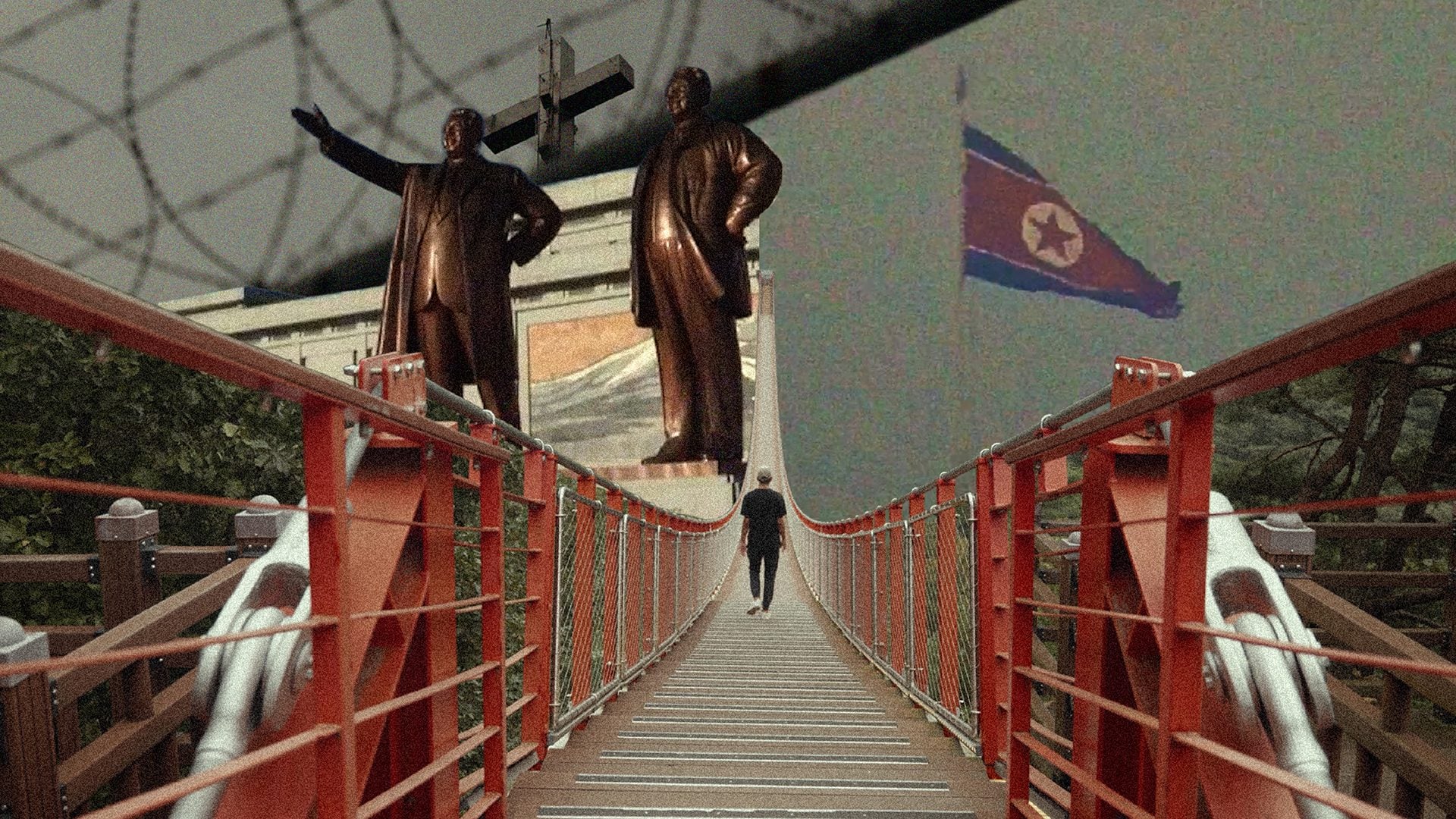

What’s really happening with the gospel in North Korea? Join Steven Morales in Hard to Reach: North Korea, as he explores one of the most spiritually closed nations on earth.
From Seoul’s Yeouido Plaza to firsthand conversations with North Korean defectors and underground church leaders, this documentary uncovers the untold story of Christianity in and around North Korea.
Hear from Grace Jo, a defector who escaped the brutal regime, and Eric Foley from Voice of the Martyrs Korea, as they shed light on the hidden growth of the North Korean church—even under intense persecution.
Discover the history of Christianity in Korea
Hear powerful stories from those who’ve escaped the regime
Learn how the underground church spreads in the world’s hardest places
This is Hard to Reach: North Korea—a story of suffering, faith, and gospel courage in the face of unimaginable opposition.
Billy Graham on Video:
There’s only one hope for the world, and that is Jesus Christ dying on a cross.
Steven Morales:
In 1947, Billy Graham set off to host his first evangelistic campaign. More than 6,000 would gather in Michigan in the United States in what would mark the beginning of a once in a generation movement. He called these evangelistic campaigns crusades, and he’d go on to do 417 of them, preaching in 6 continents, 185 countries, and over the course of his life to more than 200 million people. These events were massive, but one would stand out from the rest as his most attended crusade and perhaps with the most unlikely audience. And it happened right here where I’m standing.
On Sunday, June 3rd, 1973, at around 3:00 in the afternoon, over 1.1 million people would come from all over Korea here to Yeouido Plaza. This used to be an airstrip during the Korean War and a generation before, Christians were being persecuted here, but now they were coming for three days to hear the good news of Jesus. People were ecstatic to be here and to hear this message. They stayed in tents just so they wouldn’t have to go home.
Take a moment to consider. We’re talking about roughly three million people over the course of three days in a country of 30 million people. That’s 10% of the population all descending on one place. And by the way, that place is in Asia. This isn’t Europe during the Reformation or the United States during the Great Awakening, and yet thousands responded to Graham’s call to repentance and to follow Jesus. Aware of the context, he made a very specific call.
Billy Graham on Video:
You have to give up all other Gods and turn to Jesus Christ only as your savior. Stand up and say today, “I want to receive Christ.”
Steven Morales:
The Billy Graham Library reports that more than 12,000 people asked about receiving Christ that last day, with thousands more reaching out in the weeks that followed. Last year was the 50th anniversary of that crusade, and the impact of Billy Graham’s sermon is still evident today. Seoul is an epicenter for Christianity. There are churches and crosses everywhere. You know where the world’s largest Presbyterian, Methodist, Baptist, and Assembly of God churches are? Right here in Korea, which makes Korea’s neighbor to the north all the more staggering.
Because today, less than 30 miles away from here, where millions gathered to hear Billy Graham speak and where some of the largest megachurches in the world stand, lies a place that tells a different story for Christians. Having a Bible could lead you and your family to be sentenced to death in a labor camp. Even just expressing curiosity about Christianity could lead to life in prison. It’s hard to overstate North Korea’s intense desire to suffocate any and every gospel effort. So how is it that these two places on the same tiny peninsula in Eastern Asia respond so differently to the good news of Jesus?
My name is Steven Morales, part of the team here at Radical, and we’ve been documenting stories as God works around the world in difficult places. We’ve been to Iran, Colombia, Turkey, Japan, exploring the questions and stories of God’s power to advance the gospel to the most unlikely places.
We often think of places of persecution as so distant and foreign to us, but I want to invite you with me on a journey to the Korean Peninsula to a place where megachurches and labor camps exist just miles from each other. And I want to ask, how did this even happen? And what does this have to do with your church? And how did one of the world’s largest hubs for the gospel grow right next door to the country that wants to extinguish it the most?
This is hard to reach North Korea. So what are we referring to when we say Korea and why are there two of them? Well, we’re talking about this peninsula. After the end of World War II, the peninsula was divided into South and North Korea. The official name of the south is the Republic of Korea, and the north is called the Democratic People’s Republic of Korea. We’re going to talk more about why Korea was split in two in a minute, but that divide is a relatively new development.
Korea’s history stretches back at least five millennia and has survived foreign incursions from most of its neighboring countries, including bouts with Mongolia, China, and Japan. They even fought against Genghis Khan. The term hermit kingdom was first given to Korea centuries ago because they’ve always fought to maintain their identity as a nation in isolation from the rest of the world, which makes it all the more surprising to discover how Christianity arrived at its door.
The first Westerner to ever set foot on Korean soil was a Spanish priest named Gregorio Cespedes. He came to the southern part of the peninsula in 1593 in an attempt to do missionary work among Koreans. But whatever progress he made, Korean authorities made sure to reverse it. This was a hermit kingdom after all, and it saw Christianity as a threat. That is until 1883, when a Korean trader called So Seo Sang-ryun felt gravely ill in China, and he was treated by a Scottish missionary named John Ross. Ross had been praying for a way to serve Korea, and this was God’s answer. He shared the gospel with Seo and Seo believed. Together, they translated the Gospel of Luke into Korean, which Seo then smuggled into his homeland.
Not too long after, he gathered a group of new believers and transformed his own house into what was the first Protestant church on the Korean Peninsula. They met secretly in a remote fishing village called Sorae, just across the border of present day North Korea. And even though they worshiped behind locked doors, the doors to the Korean Peninsula were just opening up. That house church was the first unofficial church on the Korean Peninsula. There were around 30 people in the Sorae Church, and they made up the majority of the entire Protestant population in the country.
So Sorae Church was meeting in secret during a very unique time in Korean history. These were the last days of what is known as the Joseon age, a time marked by political unrest and revolts. And in one particular attempt to overthrow the government, Empress Myeongseong’s nephew was badly injured. He was almost killed. So the Empress called on the best doctor she could find, Dr. Horace Allen, who had just arrived in Korea as a medical officer for the American legation. Dr. Allen was rushed across the city to care for the Queen’s nephew, and he managed to treat the prince’s wound and nurse him back to health.
In gratitude, Korean authorities allowed Allen to open the first Western hospital, making it the first Christian organization in all Korea. The doors were now wide open for foreign missionaries to come work and eventually also build schools. This hospital is now part of Yonsei University, one of the most prestigious institutions in Korea, and Christians were at the center of it all. In fact, Christianity begins to spread now more than ever. And you might be surprised to learn that the first city to become a hub for Christian activity, so much so that it was nicknamed the Jerusalem of the East was not Seoul, but Pyongyang.
The capital of North Korea today was once home to a revival and model for what God could accomplish through the mission efforts of foreign and local missionaries. Now, I wish I could tell you that after this, it was all smooth sailing for Korean Christians, but just as Christianity was expanding on the Korean Peninsula, another major event changed the course of history.
While Christianity was making slow and steady progress, Korea was also in the middle of an all out war between China and Japan. In 1895, Empress Myeongseong, the same one that was used by God to create a welcoming climate for Christianity was assassinated. In the aftermath, Korea was annexed by Japan in 1910, and Japanese occupation proved callous to Christianity’s growth.
The newly formed Japanese Empire wanted to ensure that all of its subjects were homogenized, and Christianity’s influence was far too Western for them. They made every effort to discredit or kick out Christian missionaries. They tortured Christians. They burnt down churches and brought fake charges against prominent Christians alleging that theirs was a Western religion.
And when violence didn’t work, the Japanese built Shinto shrines throughout all of Korea and forced people to participate in their ceremonies. Christian schools were forced to close if they weren’t part of these ceremonies. And once the Japanese openly attacked the United States at Pearl Harbor, all foreign missionaries were forced out of the country. The whole world found itself at the brink of war, and Korea was right in the middle of it.
It’d been decades of struggle. Korea was still under Japanese occupation, and even in the midst of a world war, the Japanese Empire was doing what it could to erase Korean culture and their way of life. It seemed like the miraculous advances that Christianity had made were at risk of disappearing. And then the bombs dropped.
By the end of World War II, Japan, along with the other Axis Powers, was hit with fines and strict limitations and was ultimately forced to surrender its territories. Could this mean that finally Korea could be free once again? While Korea finally obtained freedom from Japanese occupation, it would soon become more divided than ever before.
Old Documentary Video:
In Seoul, the new Republic of South Korea was proclaimed, but political independence was the beginning instead of the end of trouble. While the world wondered, communism marched again.
The big break came in April 1953 with Little Switch.
“We have stopped the shooting, therefore I am thankful. The path now is to put the ceasefire agreement into full effect and get down to working out an enduring settlement of the Korean problem.”
Steven Morales:
And while Christianity flourished in the south, North Korea would become an iron fortress, seemingly impenetrable by the outside world, especially Christians. And yet, today, North Korea might just be the most religious place in the world, just not in the way you think.
There’s an eerie sense of mystery that surrounds North Korea. Hardly any outsiders get in and those who do know very little about what’s actually happening within these borders. There are secrets that North Korean leaders don’t want to get out, secrets about, unimaginable suffering and human rights violations that people experience. Over 40% of its population is malnourished and you can read reports of widespread food shortages. Electricity is in short supply with most places only getting a few hours a day.
Life in North Korea is extremely regulated. Their dress, their hairstyle, all of it needs to be government approved. There’s essentially no freedom of speech, religion, press, or anything else the free world enjoys. And the consequences for those who resist are fatal. There’s a lot North Korea doesn’t want the world to see, but as hard as it is to get in, it’s even harder for those who want to get out.
News Anchor 1:
A North Korean defector fleeing across the border, collapsing in a hail of bullets, dragged to safety by South Korean soldiers.
Steven Morales:
On November 13th, 2017, Oh Chong-song attempted the impossible and he lived to tell the tale. It’s a miracle he’s alive. He was shot five times by his countrymen and lost more than half of his blood. But he survived, and he’s not the only one. The more we learn about what’s happening in North Korea, the more I begin to wonder, how did it come to this? What drives someone to cross a minefield in hopes of a better life? I want to get as close as I can and try to understand what life really looks like in North Korea. I want to know, can the gospel get into a place built to resist it? And what happens to those who can’t get out?
David Platt:
We are standing here at the border of South Korea and North Korea with the demarcation line between these two countries right behind us. Kind of overwhelmed, my heart’s heavy just looking out into the reality of persecution and to the reality of unreached. And then on top of that, just starvation and other major physical needs. So it’s just pretty overwhelming.
Steven Morales:
That’s where we’re heading now. David came here like 10 years ago, and since then, things have only gotten worse. Various sources report that starvation today is the worst it’s ever been since the North Korean famine of 1990, where anywhere from 250,000 to 3.5 million people starve to death. These conditions are staggering and the only people who are better off are those in leadership. That’s why most North Koreans go through every effort to become members of the Workers’ Party of Korea, the ruling party reserved for those who prove their full allegiance, body and soul to the Kim dynasty.
You can see why Christians are a major target. The Democratic Republic of Korea treats any sign of Christianity as hostile, with recent reports that being found in possession of a Bible is a crime punishable by execution. There are tens of thousands of Christians right now in forced labor camps for the crime of believing that Jesus Christ is lord.
A report by the United Nations said that the gravity, scale, and nature of these violations reveal a state that does not have any parallel in the contemporary world. And it’s all behind one border, considered one of the most dangerous places in the world, the demilitarized zone that divides north and South Korea. We’re about to get there.
Even though it’s called the demilitarized zone, there are tens of thousands of troops patrolling both sides of the border, plus another 750,000 on the northern side, another half a million on the southern side within a hundred kilometers. And if that wasn’t enough, there’s also over two million landmines. At the end of World War II, having defeated the Axis Powers, the United States and Allied Forces forced Japan to surrender its territories, most notably Korea. At this point, the Korean Peninsula was split into two, with the Soviet Union controlling the north and the United States governing the south.
The north immediately began major reforms, including the redistribution of land and property. The communist government was suspicious of anything that could be construed as rebellious thinking. And wouldn’t you know it? Christianity fit that bill, so many Christians migrated south. Pyongyang, which was once known as a Jerusalem of the East, a model of how Christianity could transform a nation was abandoned.
It would all get worse. This division between North and South was only supposed to last a maximum of five years. The plan was to prepare an official government that was wholly, Korean, completely independent, and totally united. But things were heating up between America and the Soviets, and it was immediately felt all the way up to this line. And suddenly, it all came crashing down in 1948. The south held elections that resulted in a Democratic president. While over in the North, a new dynasty would rise, one that would transform the peninsula forever. And it started with a name that every Korean would soon learn, Kim Il-Sung.
There’s a song, it’s called Thank You Father Kim Il-Sung. It’s the first thing North Korean parents are supposed to teach their kids. It all sounds kind of worshipy, doesn’t it? And it actually kind of is. The US Commission on International Religious Freedom reports that the Kim dynasty is much more than an authoritarian government. It also holds itself out as the ultimate source of power, virtue, spiritual wisdom, and truth for the North Korean people. Every home in the country has a portrait of the Kim dynasty, and inspectors visit the homes and hand out fines if the portraits are not well-kept. This isn’t just respect. It’s full on veneration. They’re not just interested in political power. They want to be worshiped.
It’s not a coincidence. If you dig a little into the history of the Kims, you’ll quickly learn that this whole system of worship isn’t very original at all. In fact, it has its origins in a place that you and I go to every week. It’s hard to understand how important Christianity was to Korea before World War II, but like we talked about in episode one, Pyongyang was known as the Jerusalem of the East, with hundreds of thousands of Koreans turning to Christ. At the time, there were more than 800 Christian schools for Korean children and missionary efforts were thriving. Some estimate that one out of every five or six Koreans was a Christian at the time. Korea was no stranger to the gospel, and neither was Kim Il’s son.
Grace Jo Kim:
The North Korean regime is built upon the Marxism and socialist ideology, but Kim Il-Sung, he, a little bit, modified because he was grown up as a Christian child and his mom was the elder lady from the church. So he was grown up full of Bible stories and he had enough knowledge about the Bible. So I think after we become the Christians, we can find a lot of similarities between our regime system and our society activities and all those church services in America and all those songs in the Bible, gospel songs. It just changed the character in the song. So in North Korea, we were praising and we were singing for our dear leader, but if we change it that leader to God, then we are praising God and praising Jesus.
Steven Morales:
So essentially, Kim Il-Sung took what he learned in the Bible and made him himself God in that story.
Grace Jo Kim:
Yes.
Steven Morales:
Rather than the one worshiping God, the one being worshiped, like a god.
Grace Jo Kim:
Yeah.
Steven Morales:
This is Grace Jo Kim. She was born in 1991 in the Hamgyong Province in North Korea. She escaped North Korea in 1998 and with the help of a Korean pastor has been living in the US as a refugee since 2008, raising awareness for the desperate needs of the men and women and children forced to live under the North Korean regime. She’s also a follower of Jesus who understands how the Kim dynasty is distorting the Christian faith for personal gain.
Grace Jo Kim:
If I go back to 1996, I was five and a half years old at the time and my family were constantly starving. And I remember I was drinking cold water from the nearby river for 10 days straight without eating any food or protein. And then about two years, we were constantly hungry like that and we were trying to search some food from the government operated farms, but we couldn’t find any. We also lived in the mountain to collect wild vegetables, wild fruits, but that doesn’t help a lot. And then winter season is the most difficult season for North Korean defectors because it’s hard to find the natural food from the nature too.
So after for two years starvation, we all were suffering with malnutrition. And my father, he decided to go to China to get help from one of his distant relatives back in 1997. And he went to China for three times. And the third time when he came back, he got caught and he were detained in the local detention center. And a lot of chaos happened and tragedies happened in that year, but if I make a short story, we lost our father to our regime.
And my grandmother, she passed away by starvation and her last wish was to eat one baked potato. And my younger brothers, they died by hunger. And my oldest sister, she was looking for food and she left to city to find food, but she never returned. So we lost our sister. And she was 17 years old and my mom suspect that she was sold to China by a human trafficking ring. And my mom, she got tortured and she gave birth to a premature baby, eight months old premature baby. And that baby only lived for two months during that difficult time. And that baby brother also died after two months later by starvation.
And after my father died, my grandmother died and everybody scattered, my mom was also very weak because the government took her to the detention center and tortured her. She was bleeding and her just physical body was so weak at the time. So she cannot carry one of my younger brother. He was five years old and I was almost seven. And one of my older sisters, she was 10 years old at the time. But even though all the family members passed away and we didn’t have food to eat, my mom still didn’t think that we’re going to escape our country forever.
But the last thing kind of gave her strength to leave our home country is that our government officials, about six of them came to our house and then they were yelling to my mom. And their idea is to let us leave that countryside because our family kind of become the criminal family according to North Korean law and then they’re not welcoming our family to stay in that village anymore.
The reason they’re asking us to leave is that after a month later, we all have to vote for Kim Jong-il, presidential election or something. We only elected for one person, but we still need to elect, right? So they are asking, “Oh, you guys have to go back to your original city to vote.” But at the time it was July and my mom was crying to them and begged them that, “Oh, my children. We don’t have shoes to wear and we don’t have clothes or food. Where we can go when this is our home? Please don’t let us go.”
But those people, what they said was, “After 15 days, we will come back and check and if we still found out you guys are still living here, then we will burn this house down.” So that was the last words we heard from our government officials. And my mom just completely just changed her heart and said, “Well, this is not my country anymore.”
Steven Morales:
Every four to five years, North Korea holds local elections like the ones Grace Jo just described, with the most recent being this past November. However, more than being opportunities for any significant change, they really serve as instruments to restrict internal movement and to track the whereabouts of Korean citizens. There’s only one choice on the ballot paper and the booths are overlooked by the portraits of the Kims as you cast your vote. It’s all part of an elaborate ruse that’s meant to keep the Kims at the center of power. And at its core, you’ll find an ideology that you’ve probably never heard of, Juche.
Grace Jo Kim:
I think Juche is the main core value of ideology that Kim Il-Sung modified from Marxism and socialist ideology. So the Juche ideology’s core point is that men is centered, men is the intelligent person to change new things and intelligent men can lead the group and make a country great. Well, that’s why that kind of lead that Kim Il-Sung is the intelligent guy and he’s the special person and who made North Korea independent and made the whole country and he’s the main person who can lead the whole country like that. So that Juche ideology kind of shaped him to become the god figure in North Korea.
Steven Morales:
So even though North Korea says it’s an atheist state, the Juche philosophy behaves and feels like a religion and the Kim dynasty are worshiped as their gods. It’s not hard to see how Kim Il-Sung reared in a Christian environment with his grandparents even going to seminary, recognized the power of Christianity and deviated all of its symbols to himself. But what does Juche philosophy actually look like in day-to-day life?
Every North Korean has to go to a weekly self-criticism meeting where they sing songs from a hymnal that praises the Kim dynasty. It’s wild, but it was reported that a version of How Great Thou Art was sung to Kim Il-Sung during his funeral. North Koreans pray looking at pictures of the Kims. They are taught to protect those portraits above all their possessions and that if they die, they’ll be reunited with the eternal president.
Juche has 10 principles that are taught weekly, including you shall have no greater authority in your life than the authority of Kim Il-Sung. Kim Jong-il’s birthday is called The Day of the Shining Star and North Koreans are taught that there was a double rainbow and a bright star over his birthplace. Kim Il-Sung’s speeches are studied as if they were holy books and every student from kindergarten all the way to PhDs has to memorize and study his writing. North Korea even has its own calendar. It’s based on the year of Kim Il-Sung’s birth, April 15th, 1912. To North Koreans, 2024 is the year Juche 113. It’s no wonder the North Korean regime hates Christianity so much. It exposes its lies as what it is, a fraud.
I’ve heard you say just in previous interviews and things like that, that defectors who become Christians are categorized as serious defectors. What does that mean?
Grace Jo Kim:
Our Juche ideology is similar to the Christian Bible, and the North Korean regime hates that people find out the true God, which is the Christianity through the Bible. So when we got caught as a citizens, we got caught in China and forcefully sent back to North Korea. And when we get there, the Bowibu, it is the similar level as the CIA and FBI in America. So this level will sort out those individuals by interviews, by torturing them. And they’re trying to find out whether that person ever heard about the gospel, ever met pastors and heard about the true story and true messages from Messiah.
So once they found out that that individual already went to church and read the Bible, then considered as Christians, which means, “Oh, his ideology has changed. And then they know the truth, so they will not loyal to our government anymore.” So that’s 100% that that person will stay forever in the political prison camp.
Steven Morales:
The authoritarian regime in North Korea ruthlessly tried to destroy every visible sign of Christianity. Churches, literature, and symbols have been burned and destroyed, and anybody that professes faith in Christ is categorized as hostile until death. Some estimate that as many as 70,000 citizens are imprisoned for their Christian faith. The Kims and those in power know that their whole system is based on a counterfeit version of Christianity. And they fear the power that lies in the gospel, that if their people would know the truth, they’d be set free. It sounds like a place where no Christian could survive, and yet the North Korean church is not only alive, it’s growing.
Grace Jo Kim:
North Korea, Pyongyang, once it was called Eastern Jerusalem, because we had so many Christians booming up and a lot of pastors, so they were educated the gospels in North Korea and a lot of missionaries educated and start to help people. And then all those spiritual activities began from Pyongyang. But after Kim Il-Sung took power and Soviet Union took power, the communists came in, all the Christians got persecuted, all the churches destroyed, and all the Bibles were burnt.
So when I see the current North Korea, I just feel like the evil controlling the Kim’s regime. And they are human beings, definitely not a god. They have to eat, they have to sleep, and they have to go to bathroom. So in that case, man has limited power and God has supreme power. So the main difference is God has love, but Kim, the god of a human made god, he doesn’t have love.
And God still loves people in North Korea. That’s why he rescued those North Korean defectors and trying to raise voices for those people who are not able to. So then those Christian community outside of the North Korea can pray for them and do something spiritually. As a Christian believer in spiritual world, we still need to pray for that country so then that truth can spread all over in North Korea.
Steven Morales:
I’m in Seoul, about 35 miles away from the North Korea border. And it’s Sunday here in South Korea, and so I’m going to church. But this church, it’s a little different than any other one I’ve been to. This is Saemoonan Presbyterian Church and it’s beautiful. The architects designed it to represent Saemoonan’s significance as the mother of all churches in Seoul. This building opened in 2019 on the 132nd anniversary of the church, and it’s high on the list of churches to visit here in Seoul. And I know a list of churches to visit might sound weird, but hear me out.
Today in a country that’s smaller than many states in the US, there are hundreds of churches with over a thousand members. There are three times more churches than convenience stores. There are more than 80,000 Protestant churches here in South Korea. That’s more than one church per 650 people. Today, millions of South Koreans identify as Christians. And this building, this church is a testimony to how different things are today than in the past.
When missionaries first got to Korea, they were met with resistance from both the government and the people. Christians were thought of as alien invaders, and they were persecuted, stoned even, and forced out. Things look obviously very, very different here, but there’s a case to be made that things could actually be getting worse.
Despite its incredible growth, the South Korean church is facing a major crisis. Only 13% of the younger generation considers Christians trustworthy, and only 21% of the general population thinks Christianity was even credible. Another report showed that more than 69% of those in their 20s have no religious beliefs. I never would’ve guessed, but it’s kind of crazy to think that of the two Koreas, it’s the church in the south that’s in decline. Because in the north, where Christianity is outlawed, there’s a whole different story taking place.
So what does it look like to be a Christian in North Korea anyway? Since its very foundation, the North Korean regime has treated Christianity as an issue of national security. North Korean society is split into three main classes or castes according to how politically safe or risky they might be. Protestants are categorized as Hostile Class 37 to be sentenced to life in political prison camps where they face the harshest conditions.
The US Department of State report on the conditions of Christians of North Korea gives a picture that’s honestly heartbreaking with children being arrested and whole families being taken away just for being found carrying a cross. For as long as we’ve had persecution watch lists, North Korea has always been at the very top and yet Christianity keeps making a way.
Eric Foley:
In the year 2000, essentially 0% of North Koreans inside North Korea had seen a Bible with their own eyes. But now today, as of the 2020 data, now more than 8% of North Koreans have seen a Bible with their own eyes. So we’re at a point in time in history where more North Koreans are reading the Bible than at any other point in history, where the church in North Korea is growing faster than the church in the West and the church in South Korea. And yet the mindset we still have is, “What can I do to make a difference there? What can I do to bring the gospel there?” And my response is, “Brother, you kind of waited too long.”
Steven Morales:
Things are happening.
Eric Foley:
Yeah, right.
Steven Morales:
This is Eric Foley. He’s the co-founder and CEO of Voice of the Martyrs Korea, and he’s been serving the North Korean church for decades, learning and serving alongside the church on the ground in Pyongyang and with defectors all over the world.
Eric Foley:
In South Korea and the West, the church still holds on tightly to its forms, but in North Korea, the North Korean underground church holds loosely to the form and tightly to the Word of God. We think they must gather together and hide under blankets and so forth. But man, North Koreans love to belt out hymns. North Korea is 70% mountains and you’re in a railroad spot in a mountain pass, you can look around, see nobody’s around, and man, you just belt out a song.
North Koreans, when they pray, they’re not sitting there whispering, hiding out under a blanket. They figured out how to pray even with a state security agent sitting right here, because I could say to you, “Man, my sister’s been so sick, but we’re so blessed to live here where the great leader knows and cares about each one of us who are sick. And so I would want to bring to the great leader’s attention, my sister’s illness, because I know that he would be able to cure it instantly.” So we would say, “What is that about?” We’d say, “That’s a prayer.” And so in other words, by using the language that doesn’t even raise an eyebrow, North Koreans pray. Wherever they are, North Korean Christians pray.
Steven Morales:
Even while facing the harshest conditions, North Korean Christians are finding ways to be faithful to Jesus. It definitely involves a lot of secrecy, and sometimes it even means hiding Christ from your own children.
Eric Foley:
In North Korea, school teachers, all of the officials in a city, they’re specially trained to know how to ask questions to children to cause children to betray things about their family. And so they ask questions like, “Does your family sing the songs with different words?” Understand that? Because again, many of the songs that Christians would sing are the same songs you’d sing in a Juche, that’s the North Korean ideology, Juche worship service. Does your family have a special book? Do your parents ever look like that they’re sleeping and do this kind of a thing, which is a prayer posture.
So one of my favorite stories dispels a lot of the romance people have about North Korean underground Christians. There was this girl, when she was seven years old, her parents were Christian, she didn’t know it. And so in their home, she found a Bible and her immediate thought was, “I need to inform my teacher.” Now think about that. Her thought wasn’t, “Oh, Mommy, Daddy, please, I don’t want you to get in trouble.” Her thought is, “I need to go tell my teacher.” And so her parents tied her up in a chair until they could properly evangelize her and she could testify to the Lord.
So evangelism through tied chair may not sound like the most romantic form of evangelism, but in North Korea, there is no such thing as a normal way of evangelism. So interestingly, the girl grew up and today is associated with one of the most dynamic and effective Christian ministries inside North Korea.
Steven Morales:
Estimates are that today there are anywhere between 100 to 400,000 believers, tens of thousands of whom are in prison, which made me wonder, how does anyone become a Christian in North Korea?
Eric Foley:
Basically, a person is going to become a Christian in North Korea through hearing the Word of God. And this is the thing that I think is amazing is that I have known Christians in North Korea who died for their faith knowing literally only a few verses of scripture and a few stories from the Bible because they know they treasure it as so holy and they rely on it so completely. It tells them who they are and they rely on it. And so that’s how Christians become Christian in North Korea is through hearing the Word of God and the Holy Spirit grants them the faith to be weak towards the Lord, strong towards Kim Il-Sung, but weak towards the Lord.
A lot of times you hear stories in the Middle East about people becoming Christian because Jesus shows up in their dreams. We don’t hear many of those among North Korean Christians, but we do hear stories of miraculous healings where for whatever reason, the Lord delights in bringing healing to people. And often that is their first experience of saying, “Okay, that doesn’t make sense.” In their world, the only thing that exists is the material world. So when stuff happens that you can’t explain, that’s what invites an inquiry.
But always, what’s going to bring them to faith is that someone gives them that faithful witness about the Lord Jesus. That to me is the most encouraging thing is God is just God. He’s not waiting for anybody. There’s nothing that still has to happen. There’s no other foot that has to fall. There’s nobody who has to get up and do something. The only question is whether you’re going to join in the privilege of seeing this happen. So that’s entirely up to you.
But as for God, as for the Lord Jesus Christ, he’s made his decision about North Korea. He’s called his saints there. He’s equipped them. He’s withholding from them no good thing. And in light of eternity, we will realize that they experienced God in ways that we could never imagine because we were so busily distracted by all the other stuff that we thought we needed to have. They have only Christ revealed through his Word and sometimes even just a few words here and a few words there. And for them, it is sufficient. That to me is what’s exciting.
Steven Morales:
Thank you.
Eric Foley:
Yeah, and that’s true. That is exciting. That’s worth going to jail for.
Steven Morales:
At the turn of the 20th century, Korea’s future was on the line. Christianity was on the rise. Missionaries were opening hospitals and schools and Christ was proclaimed in churches and the streets. But Japan had also arrived and was threatening to not just destroy the church, but all of Korean identity and way of life. So a group of missionaries began to gather for prayer. They wanted to see even more of Jesus in the land. They’d been doing it for months and after a while started to think about quitting since in their own words, “nothing unusual had come of it.”
Soon after, however, as they gathered in a prayer service one night, many of those present started weeping and confessing their sins. As the missionaries tried to take control of the room, they realized that another was managing the meeting and they got out of the way. A Korean minister said at the time, “It was a great sign and wonder. I saw some struggling to get up, then falling back in agony. Others, again, bounded to their feet to rid their souls of some long-covered sin. It seemed unwise that such confessions be made, but there was no help for it. We were under a mysterious and awful power, helpless, missionaries as well as Koreans.”
While the initial service had about 1,500 people gather, that year the churches grew to 79,221 members. Over the next five years, Korea would have over 300,000 reported Christians. This was astonishing, especially when you consider that just a generation before, that number was zero. The revival services went on for days, but it didn’t stop at the churches. Christians went from house to house, confessing their sins to those whom they had wronged. Even schools had to close down in Pyongyang with reports of children confessing their wrongdoings to their teachers and classmates. Korea was flooded with a widespread sense of forgiveness and repentance. And from that outpouring of the Holy Spirit, the first Korean Presbyterian was organized and the first seven Korean ministers were ordained and prepared to serve Korea, but it didn’t stop there.
Samuel Moffett, a historian born in North Korea and whose father was present at the Pyongyang Revival tells it this way, “Just as they were about to come into the meeting, one of them said, ‘We will be the first Korean ministers of the Korean church. But a real church has more than ministers. It has missionaries.’ And they looked at a young man who had come a little late into their class at the seminary and said, ‘You stoned the first missionary you saw, didn’t you? Then you are going to be our first missionary.’ And the moderator of the presbytery, my father, who happened to be the missionary that man had stoned 16 years before, ordained the man who had stoned him. And the church sent him off as their own first missionary to a strange island off the southern coast where he in turn was stoned when he first stood up to preach the gospel.”
There’s something so powerful here. The greatest revival Korea’s ever seen resulted in the sending of its first missionary, a true Saul to Paul Christian called Pastor Lee Ki Poong, who started 17 congregations in Jeju Island, far from Pyongyang. And that’s generally been true of Korean Christians. Wherever they go, their faith goes with them.
Luke:
I did not come from a very religious family. My parents were Muslims, but they were not very strict religious. But when Taliban took over, then of course attending the school and attending the mosque, you’re pretty much encouraged to that. So I was very zealous about the religion and I wanted to join the Taliban. I saw four regime changes, went through a very deadly civil war.
Steven Morales:
This is Luke. He grew up in Afghanistan in the midst of multiple Islamic regime takeovers of the government. When he was in college, he started having doubts about Islam, and that’s when he met a Korean Christian couple living in Afghanistan who invited him into their home.
Luke:
They printed one page of paper, and it was Gospel of John 1. They were nervous about it as well because it was obvious looking at my face that I was very nervous. They had to really think about it. On the other hand, they were working for the embassy, then that would make their job very difficult. Reading the Bible and hearing from them and talking, to that point, I don’t meet any other Christians beside this Korean couple. I don’t know any other Korean Christians. I don’t know any other foreign Christians. I don’t know any other Afghan Christians. I just saw their life. Not just going there and giving the knowledge, the understanding of the Bible, I see their lives.
Steven Morales:
Luke received Christ and currently serves as a pastor and church planter among Afghan refugees. He needed to leave his country a few years ago, but he credits the faithfulness of Korean missionaries for the fruitfulness in his own life.
Luke:
In the north of Afghanistan, there was a Korean construction company. Unknown man attacked and killed two of the Koreans. They were trying to convert Afghans to Christianity. And I remember that our Korean friends, they were very upset about that. It was very sad, but they said as a Christian, this is what they choose. Their entire purpose wasn’t here to just come and build roots, but they were also here to speak about the truth that they knew to others, to take the suffering and even at the point that we would be killed for our faith. And it’s okay, we’re not going to mourn for that, but we will see them. We will rejoice to others this is happening. In those days, Koreans, they come, there was hundreds of them around Afghanistan. They went village by village to share the gospel.
Steven Morales:
This is what makes this story and Korea so incredibly relevant to the global church today. As amazing Luke’s story is, there are hundreds more of Koreans serving in Afghanistan. Since the times when it was known as the Jerusalem of the East, Korea has been a missionary powerhouse. And as we wonder and pray for the future of the church in South Korea, we need to remember that this missionary zeal isn’t limited to the Christians in the south.
Eric Foley:
We found that we could work with North Koreans here in South Korea to train them, not according to Western ways of mission or South Korean ways of doing mission, but according to the traditional North Korean underground ways of doing evangelism discipleship. When we train them, we take them out wherever North Koreans are found, which is North Korea, China, Russia, Mongolia, Southeast Asia, Middle East, even Libya, Eastern Europe. Our best missionary, in fact, she’s a woman who’s pushing 90 years old and she’s getting ready to go back inside North Korea and we’re like, “Hey, that’s a one-way trip.” And she says, “Look, I spent my whole life laying down my life for Kim Il-Sung. Why wouldn’t I lay down my life for the Lord Jesus?”
Billy Graham on Video:
You have the leadership. You have the scholarship. You have the people.
Steven Morales:
When Billy Graham came to Seoul in 1973, the North Korean regime was not happy. They reportedly called Billy Graham the witch doctor from America. And you might well think, even though Billy’s been all over the world, North Korea is probably the place he’d never reach. But 20 years later, he was actually invited to visit North Korea and meet directly with Kim Il-Sung. Graham wanted to hold the crusade in Pyongyang, but they were never going to let that happen. However, he was able to preach one message in their government sanctioned house of worship and give the ruler of North Korea a Bible. In a country where simply owning a copy could send you and your entire family to a prison camp, here comes a foreign pastor and he hands one right to the man responsible for these atrocities.
Even though North Korea has been at the top of persecution watch lists for decades, it doesn’t mean God isn’t at work in this hard to reach place. To believe that there’s a place too hard to reach or a people group too lost is to believe in a God that can only do easy things. And we don’t believe in a weak God. We believe in the God of hard to reach people.
One thing I learned from the Korean church is their discipline for prayer. There’s a tradition called “Early Morning Prayer”. You can find people praying in church every morning at 5:00 AM. Perhaps we can join them in praying for the people in North Korea and for the church in South Korea. And maybe a glorious revival is just around the corner.