

Inside the Small Churches Praying Big Things for Germany

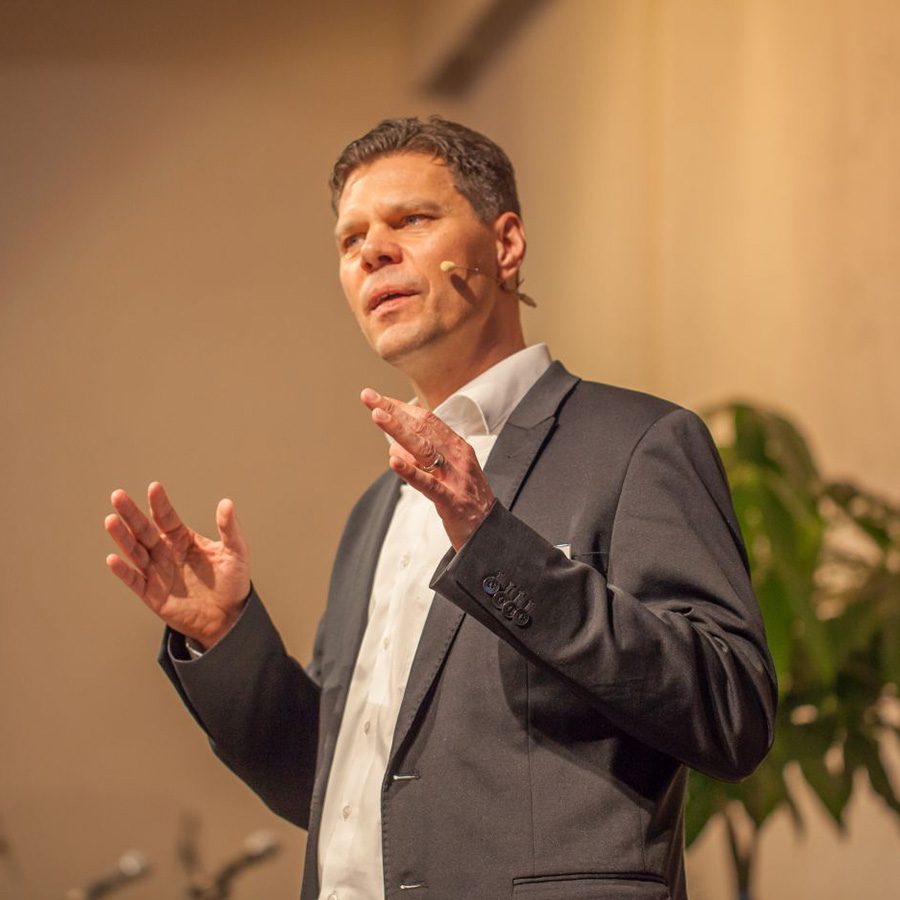
When Matthias Lohmann preached his first sermon in his home country of Germany, an older man waited at the back for him. He told Lohmann it was the first time the gospel had been preached in that church in 20 years. Keep going, he said.
Lohmann did keep going, and he now pastors the Free Evangelical Church in Munich. But the land that was once home to the Reformation is now home to the nones: Nearly half of people in Germany claim no religious affiliation at all. Of those that do, maybe 5 percent attend a church service at least once a month.
But at Lohmann’s church in Munich, there aren’t enough seats for the people who attend on Sundays. It’s an unusual problem in Germany, and one he’d like to see spread to towns and villages that have no gospel witness at all. On the anniversary of Martin Luther’s Reformation, Matthias Lohmann is praying for a revival.
I understand Germany has an official, state church that Germans have historically been members of, even if they don’t attend. What was it like when you were growing up in the church in Germany?
When I was born in 1971, pretty much everyone was a member of the church. But there was definitely no gospel being preached.
As all my friends, I was baptized as an infant into the Lutheran church. At age 13 or 14, I had confirmation class, because we were all officially Protestants. We had religion class in school, probably two hours each week. But I never heard the gospel. I didn’t know anything about true Christianity. So that’s the sad truth.
What were they teaching?
We were never hearing the gospel, and it was not even that much about morality. So, it was okay to live with your girlfriend or sleep around. All of that was fine. But be nice to old people and take care of the environment. And that was it.
Obviously, there was no message of any significance, so why would you even go to church? That was what I think pretty much every young person in Germany in the 80s, 90s, and 2000s would’ve experienced.
Is that still the case?
My parents’ generation was probably the last that had their children all baptized into the church. And ever since that it has become much less. So, most young people today don’t have religion class. They’re not being baptized into the church. They don’t go to confirmation class, so they don’t get any of that, or at least some little knowledge of what Christianity might be about.
So, what did you think about God as you grew up in this environment?
I considered God to be probably there somewhere, and Christianity as just being one way to make sense out of God, and all the other religions obviously were okay too. So, I think I was not fully agnostic. I think I was a theist, and I was certainly a universalist. So, again, I think that was very typical.
So what finally drew you to the truth?
Pretty girls [laughs]. I tried to date one, and she was a Christian—not in the state church, but in a free church, which I didn’t know existed.
Free church really just means that you are not part of the state church system. So, that’s your third alternative. You have the Roman Catholic state church, and the Protestant state church – that also means you’re paying church tax. So, 9% of whatever your income tax is is an additional tax that then goes directly to the church. And so the church was always somewhat connected to the state in my mind.
The free churches don’t go along with that. They don’t participate in the system. And, so, I considered them more of cultish sects.
So, this girl and her family, her parents, went to a Pentecostal church. And she first challenged my supposed Christian background, or being a Christian, and said she wouldn’t go out with me, she wouldn’t date me. She had a different understanding of what a relationship should look like and with whom she should be in a relationship, if at all. So, she said, yep, you’re a nice guy, but nope, that just won’t work.
What did you think about that?
Initially, I thought she just had overly protective parents, and that’s stupid, and I will rescue her out of this stupidity. But she shared the gospel with me, and I don’t remember in detail what she said…But I realized she knew what she was talking about, and I realized I have no clue. So, I went home, and I dusted off the Bible I had from confirmation class that I’d never read, and I started reading.
When did your thinking begin to change?
I had started realizing there’s more to Christianity than I’d ever known. And so, it was initially just an intellectual interest that caused me to read. I started reading up on world religions. I wanted to know a little bit more about why I should pick the Christian branch. Just because I’m in Germany, I don’t need to become a Christian, so I might just become a Buddhist or whatever.
So, I started reading up on world religions, and that was a point, I would say, where I first understood the gospel, where I first realized that Christianity is different from all other religions. All other religions tell you that you need to work your way up to God. And Christianity tells you that you can’t do that. That’s why God had to come to us in Christ. And so that made sense.
Now, again, it didn’t change my life; I just intellectually said, well, if there’s a God and he has an interest in me, working my way up to him won’t work. If he knows anything about me, he knows that won’t work.
So if he has a real interest in me, he must have come down. I mean, that’s the only way. So, I said, yeah, that makes sense. If I were God and I wanted a relationship with these crazy people, that’s what I would do.
When did all this move beyond intellectual belief for you?
A few months later, I started being convicted of sin. I had always thought, I’m just a cool guy, and that’s all fine and fun. And I suddenly realized that’s wrong. And I didn’t quite know what was happening to me.
So, I started going to that Pentecostal church. There were a lot of things that I thought were crazy, but I heard the gospel. So that’s when I kind of prayed the prayer. I think I was probably converted a few days before, but I asked: What do I need to do in order to be saved?
Good question. Acts 2, and the father of this girl, helped me to understand the gospel more. And that kind of caused me then to really call myself a Christian and realize that I’d never been one.
You were in your late 20s at that point, and already working, so how did you end up in pastoral ministry?
The very year that I was converted, my employer moved me to Washington, D.C. I was looking for a church, and I didn’t know what to look for. And I asked around, and someone said, well, I know of a lady who’s kind of a crazy Christian like you. I’ll give you her number. It was one of the greatest gifts of my life that allowed me to end up in Capitol Hill Baptist Church.
And Pastor Mark Dever ended up convincing you to preach your first sermon when a congregation asked you to preach back in Germany?
Yes, when I asked him about it, he said, Matthias, tell me the gospel in one minute or less, so I did my best. And he said, okay, so you can articulate the gospel.
So Matthias, help me to understand your question: There’s a church that asked you to come and preach? I said, yes. So that’s the Lutheran state church? Yes. Is the pastor a believer? No. Are the people in the church, are they believers? No. Will the pastor preach the gospel? No, I don’t think so. Do the people need to hear the gospel in order to be saved? Oh yeah, absolutely.
He said, okay, so you have been invited to go there and preach the gospel and you can articulate it. And what’s your question again?
I said, okay, I’ll go.
What was that first sermon like?
I didn’t know what I was doing, but I preached the gospel. I preached the whole chapter of Romans 12. And I will never forget being in this church filled with my soccer buddies. I mean, everyone thought, this is crazy. They had known me as this party-going, womanizing, soccer-playing guy. And this was something they couldn’t comprehend. How could he preach?
So, there were a lot of people in the church. But there was this one old man in the back, and he was nodding throughout the whole sermon. And when I walked out, he grabbed me, and he said, young man, the Lord has given you a gift. The gospel hasn’t been preached in this church for at least 20 years. Do something with that gift.
And this began a trajectory of you eventually returning to the U.S. with your wife, pursuing seminary training, and returning to Germany as pastor of the Free Evangelical Church in Munich. As you reach out to unbelievers now, is it similar to your own experience as a young person in Germany?
When I start a class, I say, this is a Bible. Who has ever read in a Bible?
A few people will show hands. I say, the Bible has an Old and a New Testament. People will look at you and say, oh, interesting. If you look at the 50-year-olds, they will know. If you look at the 15, 20-year-olds, a lot of people will not know. And so you get interesting questions, and that’s the positive note. They don’t think they’re Christians.
I had to be Christianized in order to be evangelized. I don’t have that problem anymore with a young generation. It’s a blank sheet of paper. They don’t know anything. And in a way, they’re not saying, I tried it and that’s not for me. They’re saying, yeah, I’ve heard about it. I have no idea what it is. Can you tell me?
And so I find this actually more helpful. I find evangelism easier today than 15 years ago, especially when it comes to the young generation.
What are the biggest obstacles?
I think the biggest obstacle that we have in our culture is humanism. That is so ingrained in our educational system. Even seminaries have to do their training based on humanism. If they want to award a degree, they cannot assume that the Bible is the inerrant Word of God, because you can’t have the Bible above men. Our intellect is above everything.
And so, if it’s supposed to be academic, if you wanted to get a degree for it, you need to study the Bible and you have to determine what is true and what is not. And so this whole humanistic mindset obviously makes the idea of a big sovereign God who’s in control, kind of a hard to grasp concept.
But we also know the true obstacle is that we are talking to spiritually dead people, so it always needs a miracle from God to open their hearts so that they pay attention to what God has to say to them through his Word. And thankfully we do see that happen.
You’re seeing lots of people coming to your church, but it sounds like there’s still a great need for a lot more gospel-preaching churches.
Yes, we have people driving for an hour or more into downtown Munich on Sunday mornings because there is just so little else. Recently a pastor, a friend from Africa, sent me an email and said, hey, I have two people moving to two cities in Germany. Can you recommend a church for them? And I said, no, both cities don’t have a good church.
Now, there are cities that have great churches. We have a great church in Hamburg, there’s great church in Cologne, there are great churches in other cities. So, it’s not that there’s nothing there. But I would say the average church in Germany is going downhill.
So, we don’t see Christianity growing in Germany. But again, I think there’s a new generation coming, and I think there’s hope. There’s always hope.
And you think the best hope for effective church leaders is training indigenous pastors?
If you look at missions, post-Christian Europe is a bit different than some of the more unreached areas, because we do still have a remnant of a church. I mean, there are people here who are Germans and there’s a young generation we are raising in our churches whom we mentor and equip.
So, I think the way to reach Western Europe is probably more through partnering with indigenous leaders and training up a new generation through them, instead of sending missionaries.
I know quite a few American missionaries in Germany, and there’s some wonderful guys. But for many, if they’re trying to plant churches, they have to learn the language, they have to learn the culture. And often they will be seen by Germans, as, oh these are the American evangelicals…And so they have a hard time.
And they [the missionaries] typically come from a background where, I’ve planted a church in Texas and after three years we had 400 people. Great, but good luck in Germany. After three years, if things go well, you might have 20.
I would say that the better way to support missions work in western Europe is find an indigenous partner, a local partner.
It sounds like there are a lot of needs, and also a lot to be thankful about what God is doing in Germany. You’ve expressed your own thanks for how churches outside of Germany have been supportive of the work there. How would you like the global church to pray for the church in Germany?
We have seen revival before, and we pray that the Lord will do it again. Pray for those who are in a position of leading healthy churches and training a next generation. Pray that we will remain faithful and will not give up.
We should plead with the Lord to sustain the faithful men, and we should plead with him to raise up a new generation of faithful men and women who will invest into the church.
Pray for the Spirit to move again in this country. God has done it before. He’s brought people on their knees to repentance and has poured out his spirit in a way that a lot of people were revived. And that’s obviously, that’s my prayer for my home country of Germany. That’s my prayer for Western Europe, that we will see that happening again.
So, join me and pray for that.