



Luke’s Christmas Story Shows How to Share Good News
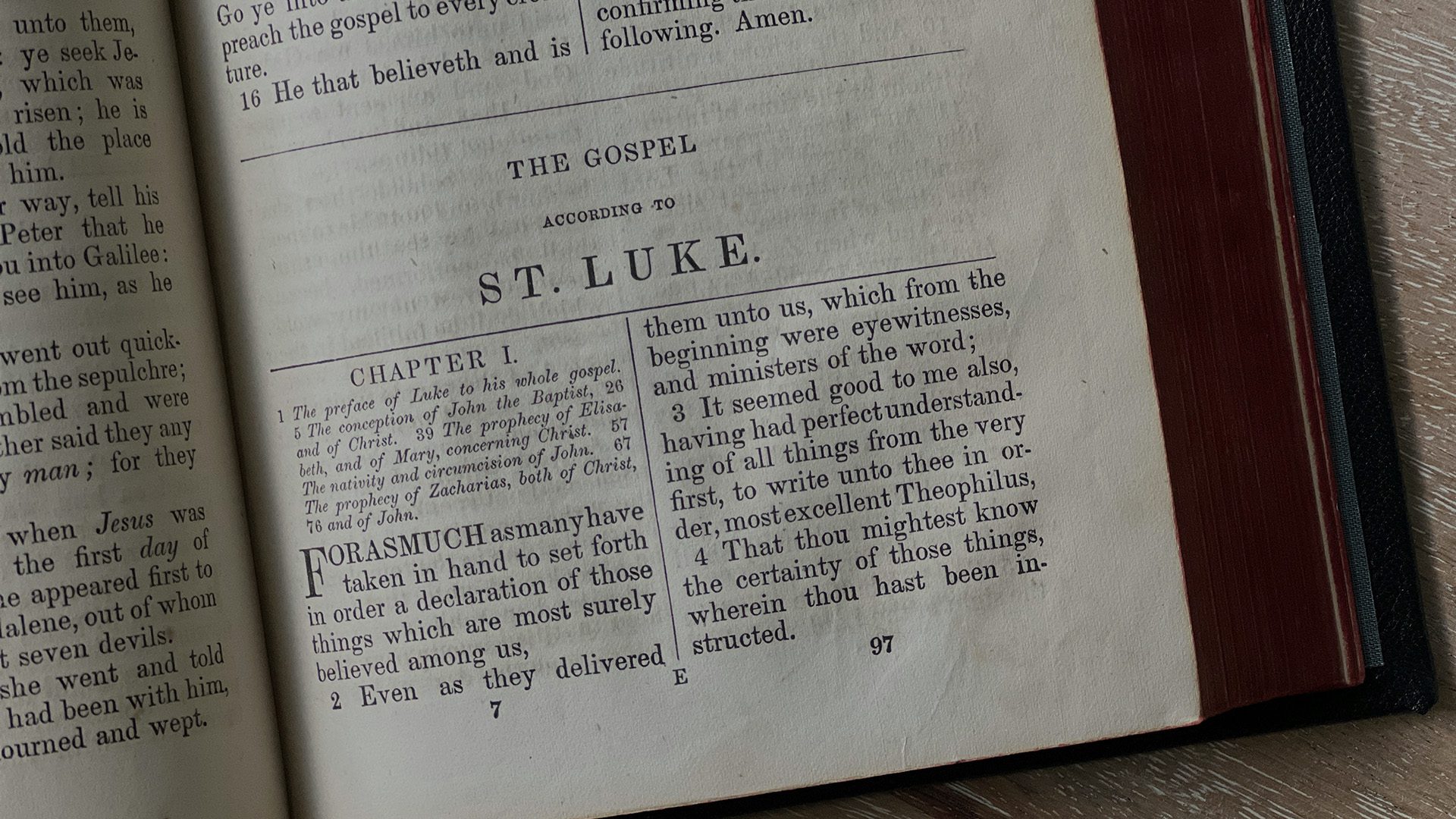
The book of Luke opens with his famous account of Jesus’ birth: Joseph and Mary travel from Nazareth to Bethlehem to register for Ceasar’s census. Mary is pregnant with her first child.
“And while they were there, the time came for her to give birth. And she gave birth to her firstborn son and wrapped him in swaddling cloths and laid him in a manger, because there was no place for them in the inn.”
We read this story every Christmas, but if we stop to hear it with fresh ears, the details are gripping. You can picture the scene. You can feel the tension, the couple’s crisis, the astounding resolution: the Savior of the world lying in a feeding trough. Angels declaring to shepherds in a field at night that this baby is Christ the Lord.
But in all the wonder, let’s not skip the story’s prologue.
This amazing gospel account of the birth, life, death, and resurrection of Jesus starts with an important author’s note. Luke wants his audience to know where this story came from.
And what Luke tells us about compiling his account of good news of great joy offers a template for how we can tell stories about how God is still working in the world today, and how the good news of Christmas is reverberating to the ends of the earth 2,000 years later.
EYEWITNESSES, HARD WORK, AND THE GLORY OF GOD
First, Luke tells his reader that “many have undertaken to compile a narrative” of Christ’s life. Luke wasn’t doing something no one else had done, but he clearly saw room to add to what already existed.
Luke also says that his sources were “eyewitnesses” to Christ’s life. He was directly connected to the community he was writing about, and he based his account on the testimony of people who saw events unfold firsthand.
He had “followed all things closely for some time past.” Luke wasn’t writing hot takes with limited knowledge and quick conclusions. He valued the time he had spent learning and listening before writing.
He wanted to write “an orderly account.” Unlike our own writing, the Scriptures are inspired revelation, but the Holy Spirit still used real people to do real work. He used the hard work of holy men to write divine words. You can almost imagine Luke researching, sketching an outline, interviewing people close to Jesus, checking his facts.
Finally, it “seemed good” to Luke to write this account. Not only did Luke think it was important to write a narrative, he thought it was good. Why? Because he had an audience in mind. He wasn’t writing to prove his access to prominent New Testament leaders; he was writing because he wanted his reader to “have certainty concerning the things you have been taught.”
So, Luke engaged in hard work, orderly work, and good work with a specific goal in mind: the good of others pursuing the glory of God.
THE STORY CONTINUES IN EVERY CORNER OF THE WORLD
Luke’s method serves as a good template for Christians telling stories about God’s work in the world today, including the stories we tell at Radical. We’re certainly not the only ones telling good stories about God’s work. There’s a lot of content out there. But we do think there’s room for more.
One of the biggest reasons we think so is because we try to carefully follow what’s happening with the gospel in hard to reach places. We talk to eyewitnesses. We talk to believers from places like Afghanistan, Iran, China, Japan, Morocco, India, North Korea, and many more. Believers who are connected to real work on the ground. Believers we’re partnering with to help get that work done.
One of our staff members puts it this way: We’re talking about real people in real places doing real things.
And while we do this, we think about our audience, something like the way Luke thought about Theophilus. We want your good. We want to encourage you. To inspire you. To help you have a global vision for your lives, wherever God has put you.
And we want you to be encouraged about the ways you’re making Jesus known in your own neighborhood or nation as well. Even if you’re doing work that feels ordinary, if you’re doing it to the glory of God and for the good of others, it should seem good to you.
I’m excited to think about how many stories are still left to tell both now and in the future. The Gospel of John ends by saying that Jesus did so many things during his lifetime that if all of them were recorded, “I suppose that the world itself could not contain the books that would be written.”
I hope the new world will.


