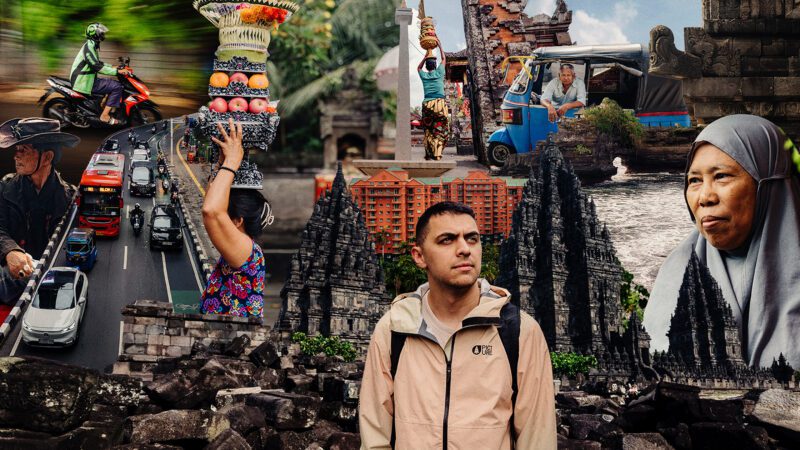
How Indonesia Became the Most Spiritually Diverse Nation


Pray for God's Word to be known in Indonesia
Pray for Indonesia
Invest in Indonesia
Invest in IndonesiaImagine visiting a country where you step out of one of the largest mosques on earth, cross a single street, and walk into a Catholic cathedral on the other side. After you leave the cathedral, imagine grabbing a taxi for a short ride to a nearby Protestant megachurch.
Imagine most of the people you meet identify as Muslim or Christian, but also believe animistic forces are shaping their lives. Imagine that though there are as many Christians in this country as there are people in Australia, Christians are in the minority, and the nation still has entire tribes still unreached by the gospel.
And imagine if you hop on a short plane ride in the same country, you’ll find an island full of Hindus.
Welcome to Indonesia: the world’s fourth-largest country, home to 280 million people, and the most spiritually diverse nation on earth.
The story of how Indonesia ended up this way, and what it means for the gospel today, is a tale of 17,000 islands, ancient religions, Muslim conquerors, Dutch missionaries, and Indonesian believers who are now reaching out to the ends of the earth, in their own backyards.
AN ARCHIPELAGO OF CIVILIZATIONS
To understand Indonesia’s diversity, you have to understand Indonesia’s geography. The nation is an archipelago of more than 17,000 islands, stretching across two hemispheres.
Nearly half the population lives on the island of Java—one of the most densely populated places on earth. Meanwhile, many other islands remain entirely uninhabited, while others are home to remote populations that have never heard of Jesus.
But Indonesia’s religious history extends far before Islam or Christianity ever arrived: The nation was once a Hindu kingdom. That’s most evident in the tourist mecca of Bali, an Indonesian island that’s home to 20,000 Hindu temples.
When Muslim conquests extended into the region of Indonesia in the 14th century, many Hindus fled to Bali as a refuge. It remains 87 percent Hindu today. In fact, most of the Hindus in the nation of Indonesia live on the island of Bali.
Though Islam prevailed in Indonesia, Christianity arrived with Portuguese Catholics in the 1500s. When the Dutch defeated Portugal, they expelled Catholic missionaries and replaced them with Reformed influence. Over the centuries, the church grew slowly, but saw much more growth in the 20th century, as other Protestant missionaries arrived.
That’s why you’ll find a Protestant megachurch displaying the Five Solas of the Reformation in the heart of the capital city of Jakarta. Today, there are 30 million self-identified Christians in Indonesia.
And you’ll find that church not far from the Independence Mosque, one of the largest mosques in the world. It’s got five levels and space to accommodate over 120,000 people. Today, Indonesia is home to 230 million Muslims.
But numbers alone don’t tell the full story.
THE HIDDEN RELIGION BENEATH EVERY RELIGION
Though most Indonesians identify as Muslim (87 percent) or Christian (10 percent), many of both groups adhere to the same underlying spiritual current: supernaturalism and animism.
Even many Christians live with a dual worldview. Some credit spirits with protection or blame them for disaster. Every loss might be a curse. Every crisis might signal that unseen forces have turned against you.
That leads many to think of Indonesia as a land that’s enchanted—or at least deeply spiritual. But beneath that spiritual enchantment lies uncertainty, fear, and spiritual bondage. That’s true for the millions who have still never heard the gospel—and perhaps for many who think they have.
Indonesia is reached and unreached. Open and hidden. Devout and fearful.
And it’s in places like this where the light of Christ is needed most.
Transcript
There are some countries where a lot of people identify as Christian, and there are some where the majority are Muslim. Some where Islam is more cultural than devout. And others where people live under Sharia law. There are some countries where people’s lives are deeply rooted in animism and mysticism. And others where some people are so remote that they are still completely unreached by the gospel.
But there’s one certain country where all of these are true.
You might be wondering how is that even possible? How can one country be a land of mosques and churches, of imams and missionaries of devotion and nominalism, of materialism and mysticism? It’s a country that’s relatively reached and incredibly hard to reach at the same time.
My name is Steven Morales, and I want to know how the most populous country in Southeast Asia, one that was originally mostly Hindu, came to have the most Muslims of any nation on earth. How does that even happen while also being home to millions of Christians and people from other religions? How did Indonesia become one of the most religiously diverse places in the world and yet still today have millions of people unreached by the gospel?
The Most Spiritually Diverse Nation
I’m in Jakarta with a metro area home to 30 million people. It’s a massive city in a massive country, and I didn’t realize this before I got here, but Indonesia is the fourth most populous country in the world right after India, China, and the US. And if you want to get an idea of how big this city is, you just have to take a look at this mosque. This is Istiqlal, the Independence Mosque. It’s one of the largest mosques in the world. It’s five levels high with a complex that can hold at least 120,000 people. It was finished in 1978, during a time when the number of Indonesians identifying as Muslim was rising. And just in the last century, the number of Muslims in Indonesia has doubled. Earlier this year, one study reported that Pakistan has now surpassed Indonesia as the nation with the highest number of Muslims. But for years, Indonesia held the title as the most Muslim nation on earth.
So when you step out of a massive mosque like this, you wouldn’t imagine that literally across the Street, you would find a Catholic church. And just 10 minutes away this, the Messiah Cathedral. It’s home to a Protestant megachurch called the Reformed Evangelical Church of Jakarta. It’s got the five solas of the Reformation spelled out all the way around the building, and this is where we begin to see the strange dichotomy. While Indonesia has a huge number of Muslims, it also has the second-largest number of Christians in Southeast Asia as nearly 30 million people. To put that into perspective, there are more self-identified Christians in Indonesia than there are people in the whole country of Australia.
But how does this all work? I mean, you don’t see Protestant megachurches in Iran or Afghanistan, but that’s kind of the point. Indonesia isn’t like a lot of other predominantly Muslim countries. It’s kind of its own world. But in order to understand the religious landscape of Indonesia, we have to start with the country’s physical landscape. Indonesia is a massive archipelago. The nation of Indonesia is actually a vast chain of 17,000 islands with nearly 280 million people inhabiting an estimated 6,000 of them. The islands straddle the equator, putting Indonesia in both the northern and southern hemispheres. About half the population lives on the island of Java. It’s not the biggest island in the country, but it’s definitely the most populated. It averages 2,600 people per square mile, making it one of the most densely populated places in the world.
Meanwhile, Indonesia also has islands with no people or very few, and some of those populations remain really remote. There are cultures within cultures here, making it one of the most diverse countries in the world. So what does this mean for Indonesia’s religious landscape? Well, let’s hop on over to a little island you’ve probably heard of before.
Bali’s Religious History
Bali has become one of the top tourist destinations in the world, and this is what you’ll see on Instagram. White sand beaches, turquoise water, the wildlife. But Bali is also an extremely religious place, just not Muslim or Christian. This is the Ulun Danu Beratan Temple. It’s one of over 20,000 Hindu temples in Bali alone. And for centuries, Bali has been known as the island of the gods.
But wait, I thought we were talking about Islam and Christianity. Well, we were, but this is Indonesia. So there’s more to the story, and Bali takes us back even further into Indonesia’s religious past. Before Islam or Christianity arrived, Indonesia was a Hindu kingdom. But even before that, Indonesians practiced forms of animism and indigenous religions. Those practices remained woven into the religious fabric of the country as Hindu and also Buddhist influence spread. By the 14th century, a new religion was on the horizon. Muslim traders arrived on the shores of Indonesia from other parts of Asia, and the long march of Islam began across the coastlands. When Muslim rulers began seeking control of some regions by force, some Hindus fled to the island of Bali as a safe haven. And today, despite the widespread growth of Islam in the entire country, the island of Bali remains 87% Hindu.
So Hinduism has been here from the beginning. Islam came in with force. We’re starting to see now how this place is becoming a melting pot for religions. But when did Christianity arrive?
Christianity in Indonesia
In the 1500s, Catholic missionaries arrived as Portugal colonized Indonesia. Then in 1605, the Netherlands defeated Portugal and expelled Catholic missionaries from Indonesia. This began a long period of Dutch colonization and a deep influence from the Dutch Reformed Church. German Lutherans arrived in the 1800s, but the biggest period of Christian growth came in the 20th century as many Protestant missionaries arrived. Significant numbers of people in a handful of regions embraced Christianity, including many people from Chinese backgrounds, and Chinese Christians remain a major segment of believers in Indonesia today. Still, the influence of Islam grew far larger than Christianity and became the dominant religion claimed by Indonesians by the end of the 20th century. Today, about 242 million Indonesians identify as Muslim in the fourth-largest nation on earth.
So you have Hindus in Bali. Islam is now heavily present in Indonesia. You have notable pockets of Christianity, and you have smaller numbers of people who practice Buddhism or Confucianism. But here’s the thing: it’s one thing to check any of these major religions on your ID card, but peel back a layer and you’ll find that most people actually hold a second more hidden belief system, one that touches every part of life. Supernaturalism or, similarly, animism.
A Supernatural Nation
Henry: When I talk to my neighbors, they’re worried about, “The spirit God cursed my wife, and now she can’t get pregnant”. Or, “I can’t cross this bridge because someone died there and their spirit is there and they’re going to curse me”. Or, “I got to go get this special ring that has a rock that’s going to bring success to my family”. And so it’s very much on that level.
This is Henry. He’s lived in Indonesia for years and has experienced firsthand the effects supernaturalism and animism have had in his neighborhood and among his friends.
Henry: I would say the default worldview of most Indonesians is going to be animism, and then you put your formal religion on top of that as a grid. I would say that’s just as much for Christians here.
Indonesians see life infused with spiritual forces, and spirituality often sounds harmless, even comforting. In Indonesia, they describe the sense that the world is full of meaning and mystery as enchanted. But this belief cuts both ways. If spirits are behind the blessings in your life, they’re also behind your suffering. Every sickness, every calamity, every unexplained loss might be a sign that something or someone has turned against you. And this means that for centuries, Indonesians have lived not just in wonder but in fear.
Island of Java. Dutch Colony 1883:
And the little boy asked, “Are you ready? Shall I wait for the spirit to the mountain?” And the wind blew, and the sea rose and the spirit appeared. “Many lifetimes I have slumbered under the mountain. Now I wake. They must learn what it is to earn the wrath of the spirit of the mountain.”
This historical drama gives you a picture of what people felt when tragedy struck. On August 26th, 1883, Krakatoa erupted with unimaginable force, wiping out entire towns and killing over 36,000 people in less than two days.
Anonymous Woman in BBC Interview: There are many stories about the mountain, but the spirit of the mountain broke the land into pieces. It sunk into the sea, and it was reborn out of the sea, and some people say how it will come again to destroy.
It was one of the deadliest natural disasters in human history. But this isn’t just a story from the past. Indonesia still suffers disaster after disaster. And in every generation, the same haunting questions lie. What have we done to deserve this? Why are the spirits angry with us? And will they do it again?
DW News Reporter: A powerful earthquake struck off Indonesia’s western coast in 2004, sending ocean waters surging toward more than a dozen countries since a massive tsunami swept ashore, killing more than 220,000 people.
Spiritual Complexity
Indonesia may feel enchanted, but it’s also spiritually complex. Alongside deep religious tradition, there’s fear. Fear of spirits and unseen powers. Many claim a religion, but it’s hard to know how many truly follow. So what happens when someone in a place like this does follow Jesus with their whole life? To understand, we’ll need to go straight to the source and talk to some Indonesian believers themselves.